Content Creator Planner: Structure Your Strategy
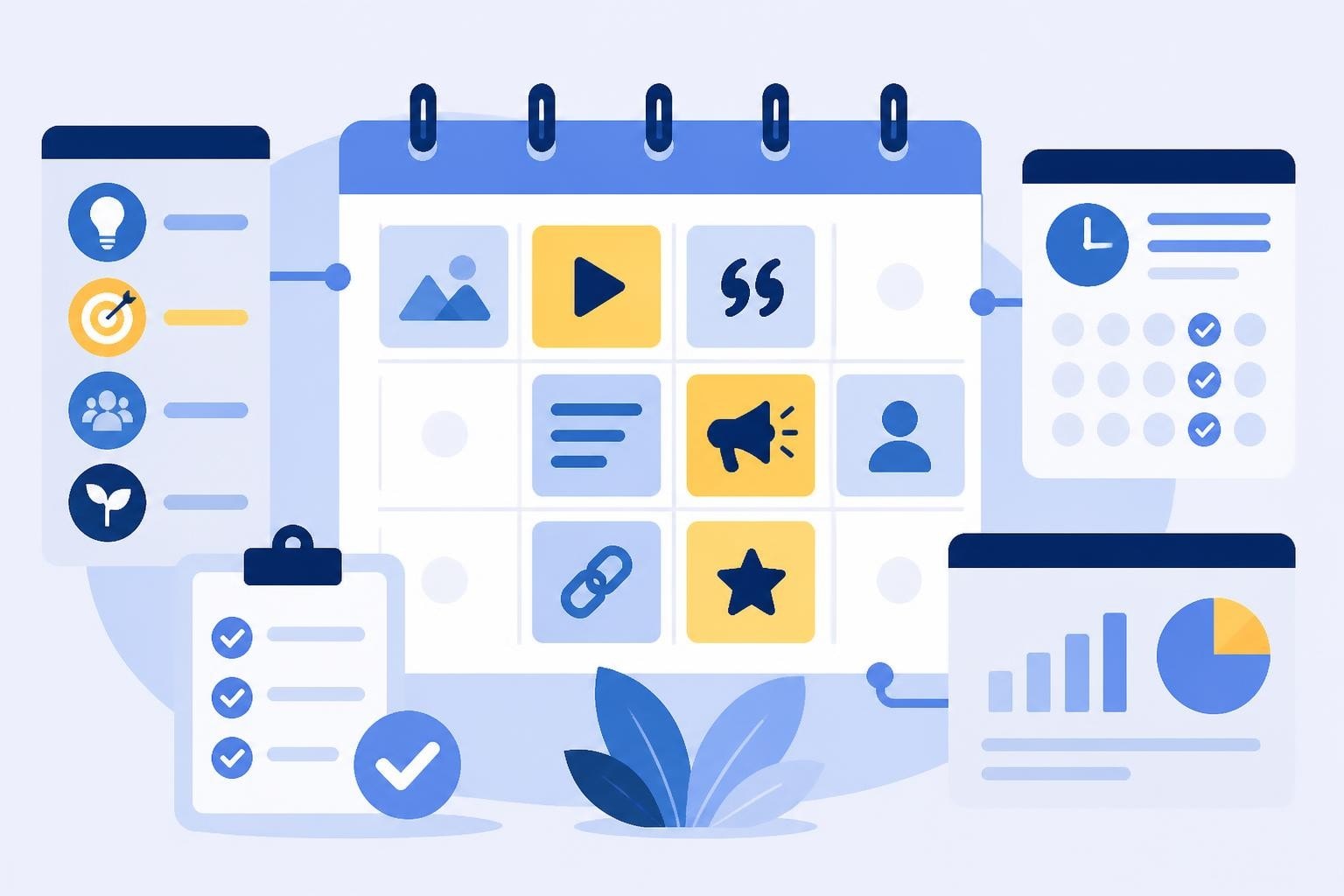
Managing a consistent flow of valuable content demands more than creativity. It requires strategic planning, systematic execution, and data-driven optimization. A content creator planner serves as the operational backbone for creators, marketers, and teams who need to transform scattered ideas into a cohesive publishing strategy that drives measurable results. Whether you're building personal brand authority or managing multi-channel campaigns, a structured approach to content planning separates sustainable growth from sporadic output.
Why Content Creators Need Strategic Planning Systems
The modern content landscape moves fast. Platforms change algorithms, audience preferences shift, and competition intensifies daily. Without a robust content creator planner, even talented creators struggle to maintain consistency, track performance, or scale their output effectively.
Strategic planning systems solve three critical problems:
- Consistency gaps that erode audience trust and algorithmic favor
- Resource waste from redundant work or misaligned content efforts
- Performance blindness when you can't connect content to business outcomes
A well-designed content creator planner transforms content production from reactive scrambling into proactive strategy execution. It provides visibility across your entire content pipeline, from ideation through publication and performance analysis.
The Real Cost of Planning Without Structure
Creators working without systematic planning face predictable challenges. They miss publication deadlines, duplicate efforts across platforms, and lose track of what content performs best. More critically, they can't identify patterns in their data or make informed decisions about where to invest creative energy.
Content Marketing Institute's guide to crafting a winning content plan emphasizes that strategic planning reduces decision fatigue and increases creative output quality. When you're not constantly deciding what to create next, you free mental bandwidth for deeper work.
Core Components Every Content Creator Planner Needs
Building an effective content creator planner requires specific structural elements that work together as an integrated system. These components form the foundation for scalable, measurable content operations.
Content Calendar Architecture
Your calendar serves as the central nervous system of your content creator planner. It maps publication dates, content formats, distribution channels, and campaign alignment in one visible timeline.
Essential calendar fields include:
- Publication date and time (accounting for platform-specific optimal posting windows)
- Content format (video, article, social post, newsletter)
- Primary topic or theme
- Target keywords or SEO focus
- Distribution channels
- Campaign or content pillar alignment
- Status workflow (ideation, drafting, editing, scheduled, published)
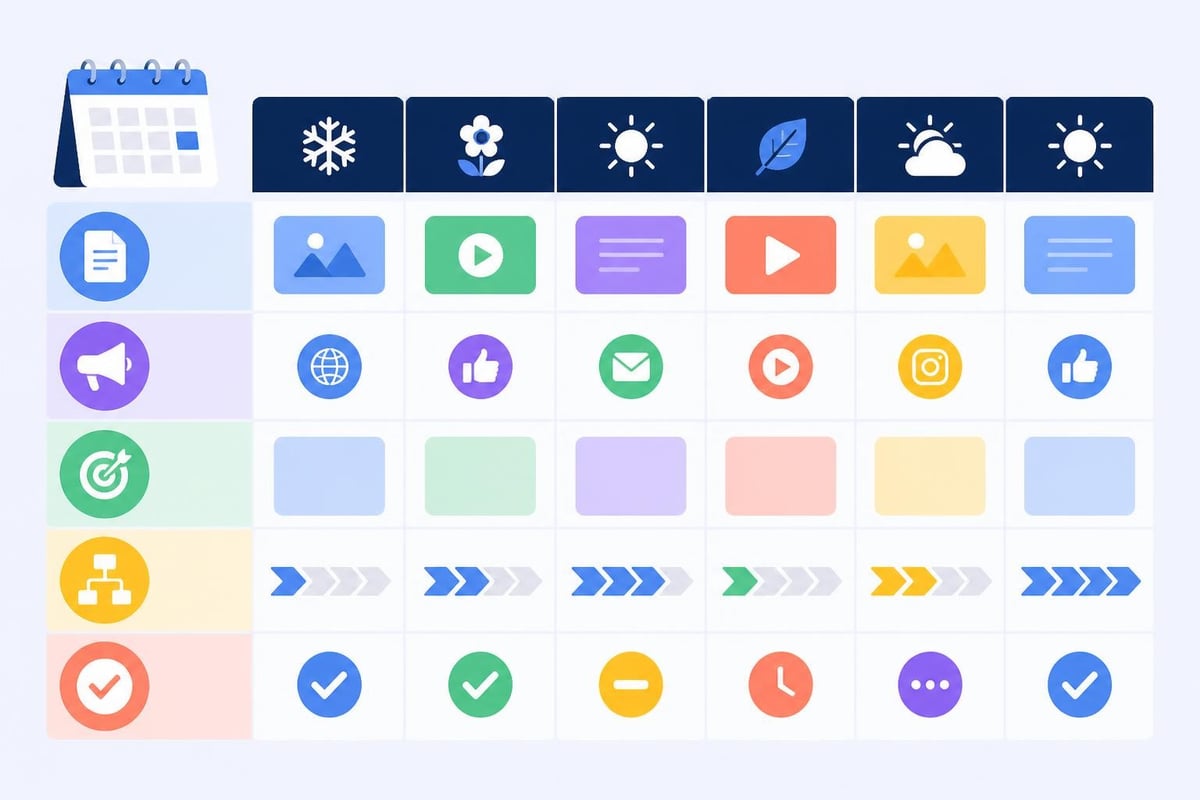
Advanced calendars integrate performance tracking directly within the planning view. This allows you to see which content types and topics drive results, informing future planning decisions with historical data.
| Calendar Element | Purpose | Frequency |
|---|---|---|
| Monthly themes | Strategic alignment | Monthly |
| Weekly topics | Execution planning | Weekly |
| Daily posts | Tactical deployment | Daily |
| Campaign windows | Revenue events | Quarterly |
Content Pillar Framework
Content pillars organize your subject matter into strategic categories that support business objectives and audience needs. A content creator planner should clearly define 3-5 core pillars that guide all content development.
Each pillar represents a topic cluster where you build authority and SEO strength. For instance, a marketing-focused creator might establish pillars around analytics, automation, growth tactics, and team collaboration.
Pillar development criteria:
- Aligns with business goals and revenue opportunities
- Addresses documented audience pain points or interests
- Offers sufficient topic depth for sustained content creation
- Differentiates you from competitors in meaningful ways
Recent Pew Research data on content creator influence shows that audiences value creators who demonstrate consistent expertise in specific domains rather than generalist coverage. Your pillar framework should reflect this focus.
Performance Tracking Integration
A content creator planner without measurement capabilities is merely a publishing schedule. True strategic value emerges when you connect content to performance outcomes and business impact.
Track these critical metrics within your planner:
- Engagement metrics: Views, clicks, shares, comments, watch time
- Traffic signals: Referral sources, landing page performance, bounce rates
- Conversion indicators: Email signups, product clicks, revenue attribution
- SEO performance: Rankings, impressions, click-through rates
- Audience growth: New followers, subscriber additions, retention rates
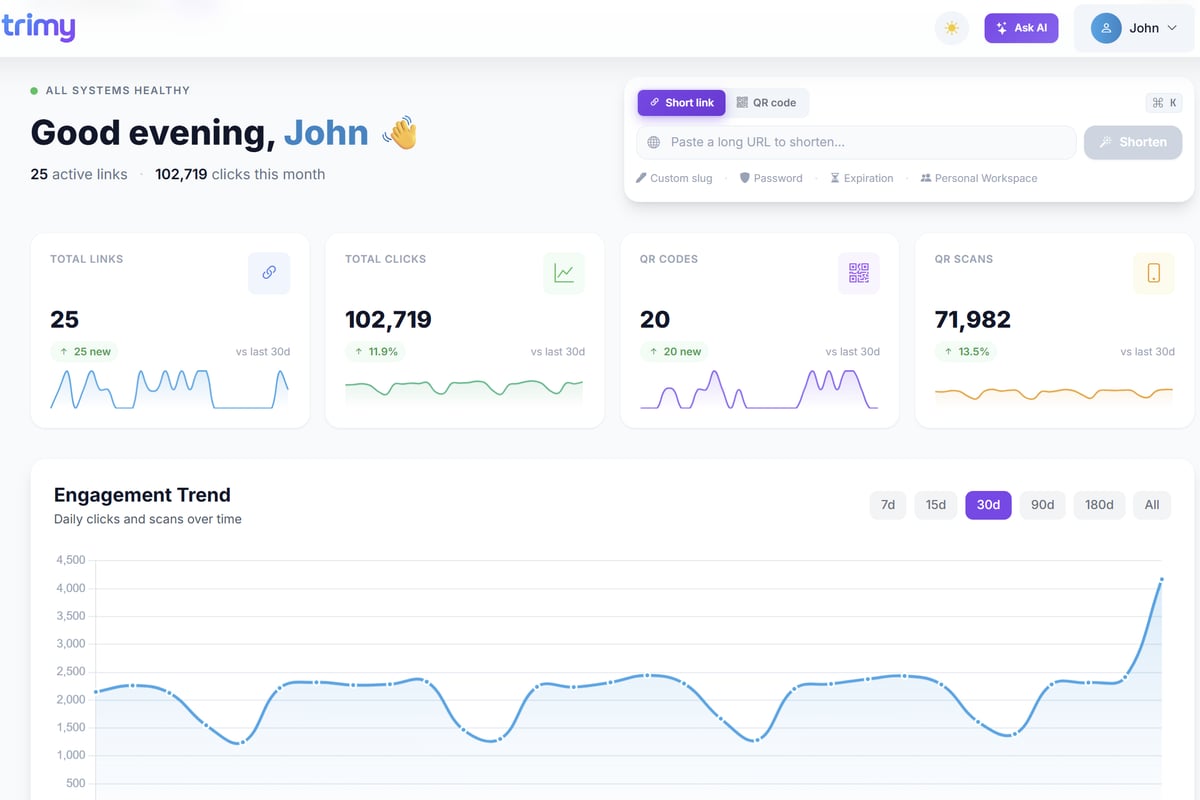
Many creators now use link management platforms to gain deeper insights into how content drives traffic and conversions. By shortening and tracking links shared in content, you can measure which pieces generate the most valuable clicks and optimize accordingly.
For teams and creators who treat content as a revenue channel, link-level analytics reveal the direct path from publication to business outcome. Trimy specializes in this intelligence layer, providing advanced analytics and A/B testing capabilities that help marketers understand exactly how their content links perform across campaigns.
Building Your Content Creation Workflow
The workflow component of your content creator planner defines how content moves from concept to publication. Efficient workflows reduce production time, maintain quality standards, and create accountability.
Ideation and Research Processes
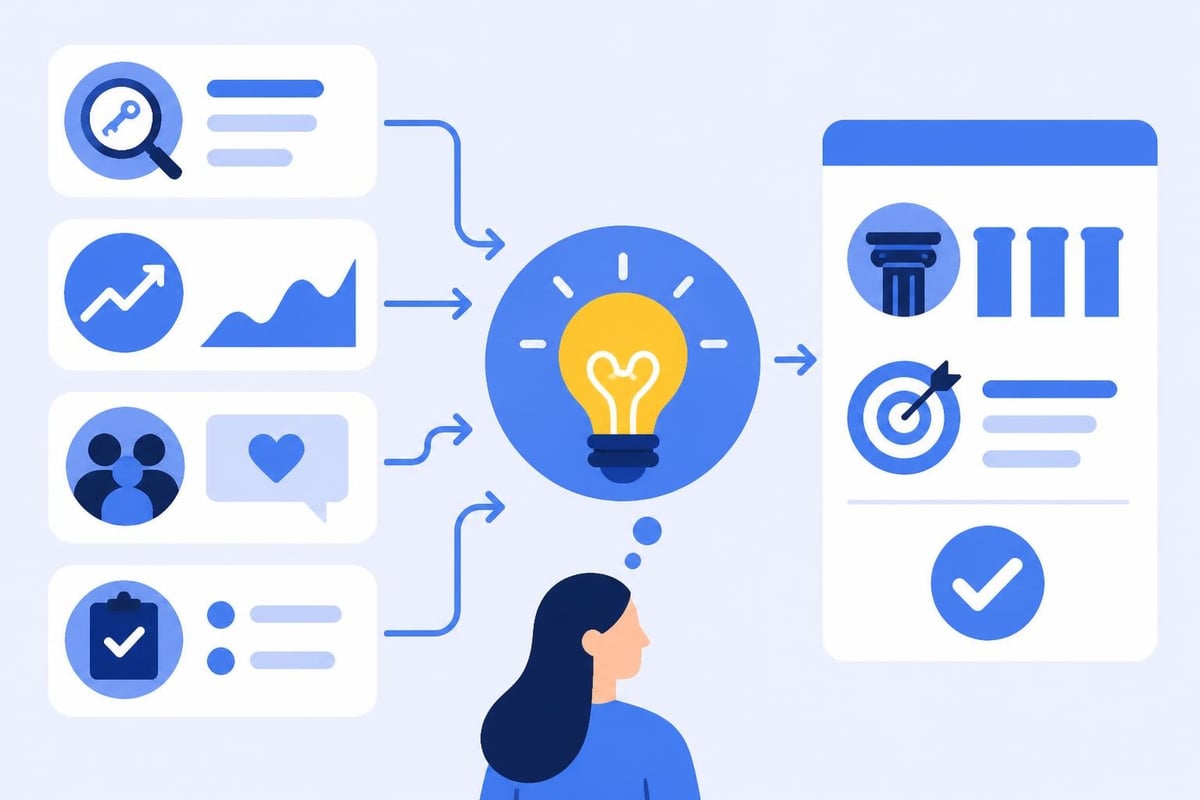
Systematic ideation prevents creative droughts. Your content creator planner should include dedicated space for capturing ideas, conducting keyword research, and validating topics before production begins.
Establish recurring research practices:
- Monthly keyword research sessions using SEO tools and Google Trends to identify emerging topics
- Weekly competitor content audits to spot gaps and opportunities
- Ongoing audience feedback collection through comments, surveys, and direct messages
- Quarterly content performance reviews to identify top-performing themes
The research phase also involves validating that topics align with your content pillars and business objectives. Not every trending topic deserves your attention if it doesn't serve strategic goals.
Production Pipeline Management
Once topics are validated, they enter your production pipeline. A clear content creator planner maps each stage of development and assigns ownership when working with teams.
Standard production stages:
- Outline/scripting: Structure the content before full production
- First draft/recording: Create initial version
- Editing: Refine, fact-check, optimize for platform
- Review: Quality control and brand alignment check
- Scheduling: Queue for publication at optimal time
- Distribution: Cross-promote across relevant channels
Each stage should have clear completion criteria and estimated time requirements. This prevents bottlenecks and makes capacity planning realistic.
Multi-Platform Coordination
Most creators distribute content across multiple platforms, requiring careful coordination in your content creator planner. Platform-specific adaptations, timing variations, and unique formatting needs all demand tracking.
HubSpot's editorial calendar templates provide practical frameworks for managing multi-channel distribution, including fields for tracking platform-specific variations and cross-promotion workflows.
Consider these platform coordination strategies:
- Core content anchor: Create one primary piece (long-form video, detailed article)
- Platform adaptations: Derive shorter versions optimized for each channel
- Timing sequence: Stagger releases to maximize reach without overwhelming audiences
- Link strategy: Use consistent, trackable links across platforms to measure channel performance
The link strategy component is particularly valuable for understanding which platforms drive the most engaged traffic. When you use unique tracked links for each distribution channel, you can optimize your cross-promotion efforts based on real conversion data.
Advanced Planning Strategies for Growth
As your content operation matures, your content creator planner should evolve to support more sophisticated strategies that accelerate growth and improve efficiency.
Campaign-Based Content Clusters
Instead of isolated content pieces, plan thematic campaigns that unfold across multiple publications. This approach builds momentum, improves SEO through topic clustering, and creates natural cross-promotion opportunities.
A campaign might include:
- Anchor piece: Comprehensive guide or flagship video
- Supporting content: 3-5 related pieces exploring specific subtopics
- Social amplification: Daily posts promoting campaign elements
- Email integration: Newsletter series connecting all campaign content
Your content creator planner should visually map these relationships and track campaign performance as a unified entity, not just individual pieces.
Data-Driven Content Optimization
Leverage historical performance data to inform future content decisions. Your content creator planner becomes more valuable over time as you accumulate performance insights.
| Optimization Area | Data Source | Planning Application |
|---|---|---|
| Topic selection | Past engagement rates | Prioritize high-performing themes |
| Format choice | Completion rates, shares | Match format to content type |
| Publishing timing | Traffic patterns | Schedule for peak audience availability |
| Headline style | Click-through rates | Refine headline formulas |
| Content length | Time-on-page, retention | Optimize depth for topic type |
Backlinko's content calendar guide demonstrates how to integrate SEO data directly into planning workflows, ensuring every piece targets validated search opportunities.
Seasonal and Trend Integration
Strategic content creator planners balance evergreen content with timely, trend-responsive pieces. Build flexibility into your calendar for capitalizing on emerging opportunities while maintaining your core publishing cadence.
Plan seasonal content 60-90 days ahead to account for production time and SEO maturation. Reserve 15-20% of your content capacity for reactive trend coverage that serves audience interests.
Tools and Systems That Power Effective Planning
Your content creator planner exists within a technology ecosystem that automates routine tasks, centralizes information, and provides analytical insights.
Planning Platform Options
- Spreadsheet-based planners: Maximum flexibility and customization, but require manual maintenance
- Project management tools: Excellent for team collaboration and workflow tracking
- Specialized content platforms: Purpose-built for editorial planning with integrated analytics
- All-in-one marketing suites: Combine planning with execution and measurement tools
Choose platforms based on team size, technical comfort, budget constraints, and integration requirements. The best content creator planner is one you'll actually use consistently.
Integration Points That Matter
Your planner should connect to tools you already use:
- SEO platforms for keyword data and ranking tracking
- Analytics tools for performance measurement
- Social media schedulers for automated publication
- Email marketing platforms for newsletter coordination
- Link management systems for traffic intelligence and attribution
Integrated systems reduce manual data transfer and provide richer context for planning decisions. When your link analytics automatically feed performance data into your content planner, you spend less time compiling reports and more time creating.
Team Collaboration and Accountability
For creators working with teams, editors, or freelancers, your content creator planner becomes a collaboration hub that aligns effort and maintains quality standards.
Role-Based Workflows
Define clear ownership at each production stage. Your content creator planner should indicate who's responsible for each task and when handoffs occur.
Common content team roles:
- Strategist: Defines topics, keywords, and campaign themes
- Creator/Writer: Produces initial content
- Editor: Refines quality and ensures brand consistency
- Designer: Creates visual assets
- Publisher: Schedules and distributes content
- Analyst: Tracks performance and reports insights
Even solo creators benefit from thinking in roles, as it clarifies which "hat" you're wearing during each work session.
Communication Protocols
Establish how team members communicate about content status, blockers, and changes. Your content creator planner should include notes fields, comment threads, or integration with communication platforms.
Regular planning meetings keep everyone aligned:
- Weekly tactical: Review upcoming content and resolve production issues
- Monthly strategic: Assess performance, adjust priorities, plan next period
- Quarterly planning: Set campaign themes, allocate resources, update strategy
HubSpot's comprehensive content marketing plan guide outlines team structures and communication frameworks that scale from small creator teams to enterprise marketing departments.
Measuring Content Planner Effectiveness
Your content creator planner itself should be evaluated for performance. Is it helping you publish more consistently? Improving content quality? Driving better business results?
Planning System Metrics
Track these indicators of planning effectiveness:
- Consistency rate: Percentage of planned content actually published on schedule
- Production velocity: Average time from ideation to publication
- Resource utilization: How fully you use available production capacity
- Plan accuracy: How often reality matches your projections
- Team satisfaction: Whether collaborators find the system helpful
If you're consistently missing deadlines or team members circumvent your planning system, it's too complex or doesn't match your actual workflow.
Content Performance Evolution
The ultimate test is whether planned content performs better than unplanned content. Compare:
- Engagement metrics for planned vs. spontaneous content
- SEO performance of strategically researched topics vs. intuitive choices
- Conversion rates for campaign-based vs. isolated content
- Audience growth during structured planning periods vs. ad-hoc periods
A well-executed content creator planner should show measurable improvements across these dimensions over 3-6 months of consistent use.
Adapting Your Planner as You Scale
Your content creator planner needs to evolve as your operation grows. What works for a solo creator publishing weekly won't serve a team producing daily multi-platform content.
Scaling Indicators
Watch for these signs that your planning system needs upgrading:
- Consistently running out of content ideas
- Frequent deadline misses despite adequate resources
- Team members working on conflicting or duplicate content
- Inability to track performance across all distribution channels
- Planning meetings consuming more time than actual content creation
When you hit these friction points, it's time to invest in more sophisticated tools or restructure your workflows.
Future-Proofing Your Planning System
Build flexibility into your content creator planner from the start. Use modular systems that can add capacity, integrate new tools, or adapt to platform changes without complete overhauls.
Document your planning processes so new team members or tools can onboard efficiently. Your institutional knowledge about what works becomes increasingly valuable as you scale.
A systematic content creator planner transforms unpredictable creative output into a reliable growth engine that compounds value over time. By organizing your ideation, production, distribution, and measurement processes, you free creative energy for the work that actually matters while ensuring every piece serves strategic objectives. When you combine structured planning with intelligent link tracking and campaign analytics, you gain complete visibility into how content drives business outcomes. Trimy provides the link intelligence layer that connects your content planner to revenue signals, helping you optimize every link, understand cross-channel performance, and make data-driven decisions that accelerate growth.