Outbound Links SEO: Strategy Guide for 2026

Outbound links-hyperlinks that point from your website to external domains-play a nuanced but important role in modern search engine optimization. While SEO practitioners have long debated their direct ranking impact, the strategic use of outbound links influences user experience, content credibility, and how search engines understand the context of your pages. In 2026, understanding outbound links SEO means going beyond simple link placement to implement sophisticated qualification, monitoring, and strategic citation practices that support both your audience and your organic visibility goals.
The SEO Value of Outbound Links
Outbound links serve multiple functions in the search ecosystem. They provide additional resources for readers, establish topical context, and signal editorial integrity when you cite authoritative sources.
Google's technical guidance on crawlable links confirms that search engines follow and evaluate external links as part of understanding page content and relationships between websites. While Google representatives have consistently stated that outbound links are not a direct ranking factor, the indirect benefits compound over time.
How External Links Influence Rankings Indirectly
The relationship between outbound links SEO and rankings operates through several mechanisms:
- Topical relevance signals that help search algorithms understand your content's subject matter
- User satisfaction metrics when readers find helpful supplementary resources
- Editorial quality indicators that distinguish well-researched content from thin pages
- Semantic connection to authoritative knowledge graphs and entity relationships
Research from Backlinko examining ranking correlations across search factors found that pages linking to high-authority external sources often performed better in competitive queries, though correlation doesn't prove causation.

Building Content Credibility Through Strategic Citations
Strategic external linking builds trust with both search engines and human readers. When you reference data, cite studies, or link to official documentation, you're demonstrating research depth and editorial standards.
| Link Practice | SEO Benefit | User Benefit |
|---|---|---|
| Citing original research | Establishes authority | Provides source verification |
| Linking to official docs | Improves topical clarity | Enables deeper learning |
| Referencing industry leaders | Creates semantic relationships | Builds confidence in claims |
| Connecting to complementary tools | Enhances content value | Solves complete user needs |
The key is selectivity. Pages with 2-5 highly relevant outbound links typically perform better than those with either zero external citations or excessive outbound linking that dilutes focus.
Link Qualification and Proper Annotation
Google introduced formal guidelines for qualifying outbound links to help webmasters distinguish between natural editorial links and those that might manipulate rankings. Understanding these annotations is central to outbound links SEO in 2026.
The Three Core rel Attributes
Google's official recommendations on qualifying outbound links define three primary relationship attributes:
- rel="sponsored" for paid placements, advertising links, and compensation-based relationships
- rel="nofollow" for untrusted content or when you don't want to endorse the destination
- rel="ugc" for user-generated content like forum posts and comments
You can combine these attributes (rel="nofollow sponsored") when multiple qualifications apply. The proper implementation protects your site from link-spam associations while maintaining transparency about commercial relationships.
When to Use Each Annotation
Sponsored links require the rel="sponsored" attribute whenever money, products, or services have exchanged hands for the link placement. This includes affiliate links, paid partnerships, and advertorial content. Failing to qualify these properly can result in manual actions from Google's webspam team.
Nofollow attributes work well for links you're required to include but don't editorially vouch for-widgets, guest post author bios, or references to competitors. They tell search engines "I'm linking here for completeness, not endorsement."
UGC markers help search algorithms discount spam in comment sections and forum posts without penalizing the host site. For most content marketing and editorial pages, you won't need rel="ugc" since the content comes from trusted editors.
Editorial Links Need No Qualification
Natural editorial links-citations to research, references to tools, links to official documentation-should remain unqualified. These standard outbound links pass the full context and association signals that make outbound links SEO valuable. Adding unnecessary nofollow attributes to legitimate citations can actually reduce the semantic clarity of your content.
Strategic Placement and Context Optimization
Where and how you place outbound links matters as much as the destinations themselves. Strategic placement maximizes both user value and SEO performance.
Contextual Relevance Requirements
Outbound links generate the strongest SEO signals when embedded within relevant context. A link to a marketing automation platform carries more weight in a paragraph discussing email campaign workflows than in a generic resource list.
Best practices for contextual placement:
- Embed links within body paragraphs where the reference naturally supports your argument
- Use descriptive anchor text that previews the destination content (avoid "click here" or bare URLs)
- Place the most important outbound links in the first 50% of your content
- Ensure the surrounding sentences establish why the external resource adds value
Research published on arXiv examining external link patterns found that contextually integrated links received significantly more engagement than those grouped in "resources" sections, suggesting both users and algorithms prioritize in-context citations.
Anchor Text Optimization
Anchor text for outbound links should be precise and descriptive without being keyword-stuffed. The goal is to set accurate expectations for both users and crawlers about the destination content.
| Poor Anchor Text | Improved Anchor Text | Why It's Better |
|---|---|---|
| click here | Google's link qualification guidelines | Describes destination content |
| this article | Search Engine Journal's outbound link study | Provides source and topic context |
| read more | Ahrefs research on link decay | Signals what reader will learn |
| visit | SEMrush's outbound linking workflow | Combines brand and topic signals |
Descriptive anchors help search engines understand the relationship between your content and the linked resource, strengthening the topical relevance signals that make outbound links SEO effective.

Monitoring and Maintenance for Long-Term Performance
Outbound links decay over time. Pages get deleted, domains expire, and content moves without redirects. This "link rot" damages user experience and potentially SEO performance.
The Link Rot Problem
Ahrefs' comprehensive study on link rot found that 66.5% of links to websites built since 2013 are now broken. For older content, the problem compounds yearly. Broken outbound links create frustration when users click expecting helpful resources and instead encounter 404 errors.
From an outbound links SEO perspective, excessive broken links signal outdated or poorly maintained content. While a few broken links won't trigger penalties, pages riddled with dead external references may see reduced rankings as quality signals deteriorate.
Building a Monitoring Workflow
Effective outbound link maintenance requires systematic monitoring:
- Audit frequency: Review high-traffic pages quarterly, long-tail content annually
- Automated checks: Use tools to scan for 404s, redirects, and SSL issues
- Manual validation: Verify that living links still contain relevant, quality content
- Update strategy: Replace broken links with current equivalents or remove references if no alternative exists
When managing hundreds or thousands of outbound links across a content library, automation becomes essential. Link management platforms can track destination status, alert you to failures, and even suggest replacement targets based on topical similarity.
Quality Degradation Beyond Breaking
Links don't have to break completely to lose value. Destination pages can:
- Shift focus to unrelated topics after acquisitions or strategy changes
- Add aggressive advertising that compromises user experience
- Implement paywalls that block access to previously free resources
- Degrade content quality through outdated information or reduced editorial standards
Regular content audits should evaluate not just link functionality but whether each outbound reference still serves your readers' needs and maintains the quality standards that support your SEO strategy.
Balancing Outbound Links with Business Goals
While outbound links SEO emphasizes linking to authoritative external sources, businesses naturally want to retain traffic and conversions. The solution lies in strategic balance rather than link hoarding.
When to Link Out Freely
Educational content benefits most from generous outbound linking. How-to guides, research roundups, and industry analysis gain credibility and user value through comprehensive external citations. These pages often target top-of-funnel awareness keywords where building trust matters more than immediate conversion.
Technical documentation should link extensively to official specifications, API references, and community resources. Developers and technical audiences expect thorough citations and view restricted linking as a red flag for incomplete or unreliable information.
When to Prioritize Internal Navigation
Product pages and pricing pages typically perform best with minimal outbound links that might divert purchasing intent. These conversion-focused pages benefit more from strong internal linking to case studies, feature comparisons, and support documentation that keeps users moving toward transaction completion.
Landing pages from paid campaigns should similarly limit external exits. When users arrive from expensive advertising channels, every outbound link represents potential revenue leakage.
| Content Type | Recommended Outbound Links | Primary Goal |
|---|---|---|
| Blog posts | 3-7 relevant citations | Build authority, provide value |
| Ultimate guides | 10-20 comprehensive sources | Establish definitive resource status |
| Product pages | 0-2 (technical specs only) | Drive conversions |
| Comparison articles | 3-5 (competitor sites, reviews) | Demonstrate fairness, build trust |
Strategic marketers optimize outbound linking patterns by content type and funnel stage, maximizing both SEO benefits and business outcomes.
Advanced Outbound Link Strategies for 2026
Modern outbound links SEO extends beyond basic citation practices. Advanced practitioners implement sophisticated strategies that compound competitive advantages.
Co-Citation and Topical Authority
Co-citation occurs when multiple authoritative sites link to the same external resources within similar topical contexts. By citing the same high-quality sources that your top-ranking competitors reference, you strengthen semantic associations between your content and established authority clusters.
Implementation approach:
- Analyze top-10 ranking pages for target keywords
- Identify frequently cited external sources across competitors
- Incorporate these authoritative references where genuinely relevant
- Add unique citations that competitors missed to differentiate your content
This strategy aligns your content with existing topical authority patterns while maintaining editorial independence through selective, value-adding external links.
Link Velocity and Natural Patterns
Adding or removing large numbers of outbound links suddenly can appear manipulative. Natural content evolution involves gradual refinement as new research emerges and older references become outdated.
When updating existing content, implement outbound link changes incrementally. If you're adding ten new citations to a comprehensive guide, consider spreading the additions across 2-3 update cycles rather than changing everything simultaneously.
Reciprocal Linking and Relationship Building
While excessive reciprocal linking (you link to me, I link to you) can trigger quality concerns, strategic mutual citation between complementary resources serves users and reinforces topical ecosystems.
Search Engine Journal's analysis of outbound link practices notes that natural reciprocal linking occurs organically when industry experts cite each other's research and insights. The key differentiator is editorial merit: link to resources because they add value, not to secure return links.

Outbound Links in Content Distribution
When you distribute content across multiple channels, outbound link strategy must adapt to platform-specific considerations and tracking requirements.
Social Media and Shortened Links
Social platforms often require shortened URLs for character limits and aesthetics. However, naked shortened links provide no anchor text signals for SEO when those social posts get indexed or referenced.
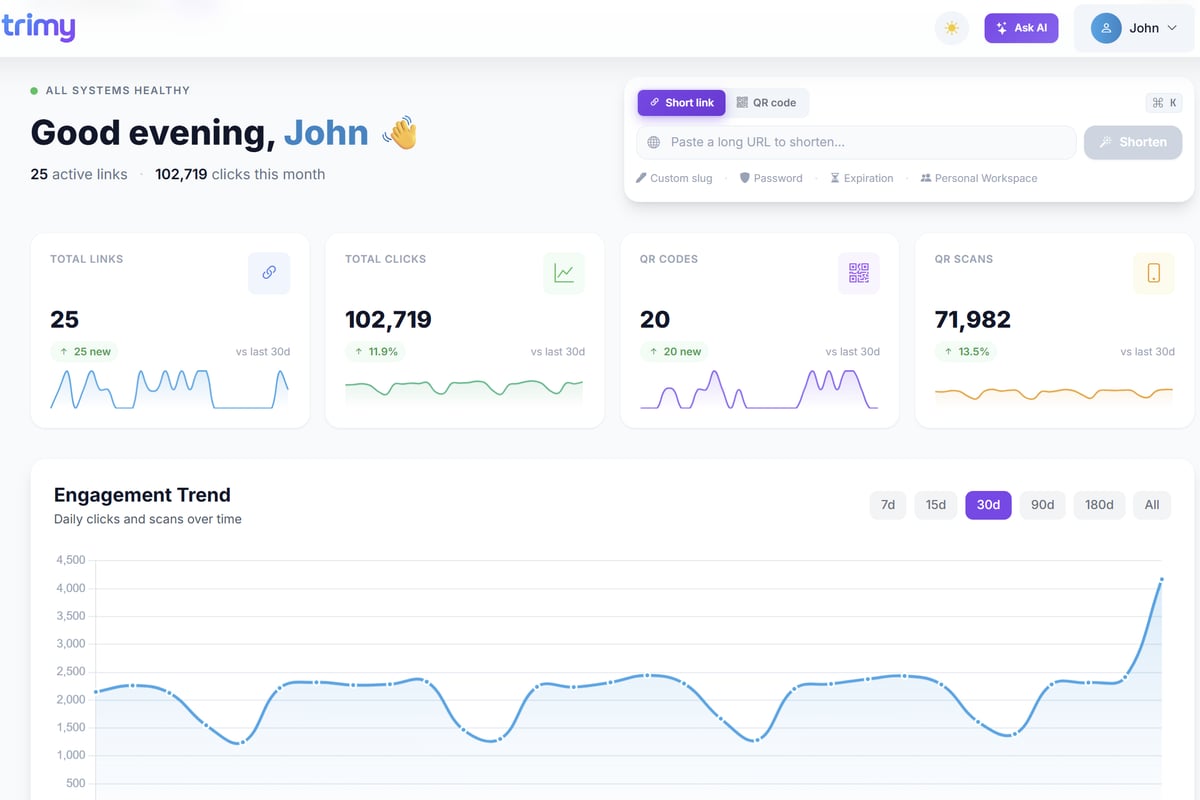
When managing campaigns that span owned content and social distribution, Trimy enables comprehensive tracking of how outbound links perform across channels while maintaining proper link structure for SEO purposes. The platform's analytics reveal which external citations drive the most engagement, helping you refine your outbound linking strategy based on actual user behavior rather than assumptions.
Email Campaigns and Click Attribution
Outbound links in email content face similar tracking challenges. UTM parameters help attribute traffic but can create duplicate content issues if email versions of your blog posts rank alongside the canonical web versions.
Implement canonical tags correctly and use link management platforms to track email-specific link performance without compromising the SEO value of outbound citations in your primary content.
Syndication and Attribution Links
When your content appears on third-party platforms, the outbound links within syndicated versions create complex attribution scenarios. Ensure syndication agreements require:
- Canonical tags pointing to your original content
- Author bylines with links back to your site
- Preservation of your original outbound link structure when editable
This protects the outbound links SEO value you've built while preventing dilution across syndicated versions.
Common Outbound Link Mistakes to Avoid
Even experienced SEO practitioners make outbound linking errors that diminish content performance. Recognition and correction of these patterns improve both rankings and user satisfaction.
Over-Optimization Signals
Excessive exact-match anchor text in outbound links appears unnatural. If every link to "email marketing software" uses that precise phrase as anchor text, the pattern suggests manipulation rather than natural citation.
Link-stuffing resource pages with hundreds of barely relevant outbound links creates thin content that provides little user value. Search algorithms increasingly discount these link-dump pages.
Inappropriate nofollow usage on genuine editorial citations can reduce the semantic clarity of your content. Search Engine Journal's coverage of Google's stance on outbound linking confirms that qualifying legitimate citations with nofollow provides no SEO benefit and may actually reduce contextual signals.
Technical Implementation Errors
Common technical mistakes include:
- JavaScript-only links that search crawlers can't follow reliably
- Redirect chains that lead to external destinations after multiple hops
- Mixed protocols (HTTP links from HTTPS pages) that trigger security warnings
- Broken attribute syntax that renders rel annotations ineffective
Regular technical audits should verify that outbound links meet Google's crawlability requirements and implement proper HTML structure.
Editorial Quality Failures
The most damaging outbound link mistakes are editorial rather than technical:
- Linking to outdated, inaccurate, or low-quality sources that damage credibility
- Citing biased or non-authoritative sources for factual claims
- Creating relevance mismatches between anchor text, context, and destination
- Failing to verify that linked resources remain appropriate over time
Measuring Outbound Link Performance
Effective outbound links SEO requires measurement frameworks that connect external linking decisions to business outcomes and user behavior.
Key Metrics to Track
Click-through rates on outbound links reveal which external citations provide genuine user value versus which merely occupy space. Low CTR on prominent outbound links suggests relevance problems or poor positioning.
Bounce rate correlation helps identify whether outbound links serve users appropriately. If pages with certain external link patterns show elevated bounce rates, those citations may distract from primary content goals or signal quality mismatches.
Time on page metrics before and after outbound link clicks indicate whether external resources complement your content or divert engaged readers prematurely.
A/B Testing Link Strategies
Systematic testing refines outbound linking approaches:
- Quantity tests: Compare engagement on pages with 3 vs. 7 vs. 12 outbound links
- Position experiments: Test performance of identical links placed in introductions vs. mid-content vs. conclusions
- Anchor variation: Evaluate click-through on generic vs. descriptive vs. keyword-focused anchor text
- Qualification impact: Measure user response to sponsored annotations and whether transparency affects trust signals
Advanced analytics platforms enable this experimentation without requiring separate page versions, tracking how link presentation variations influence both user behavior and organic performance.
Attribution and Revenue Impact
For commercial content, connecting outbound links to revenue requires sophisticated attribution:
- Track which external citations appear in conversion paths
- Measure how outbound links influence time-to-conversion metrics
- Identify external resources that educated prospects actually purchase from you
- Calculate the opportunity cost of traffic sent to external destinations
This financial perspective ensures outbound links SEO aligns with broader business objectives rather than operating in isolation from revenue considerations.
Industry-Specific Outbound Link Approaches
Different industries face unique outbound linking considerations based on regulatory requirements, competitive dynamics, and audience expectations.
Regulated Industries
Healthcare and financial services content must link to authoritative, regulated sources. Citations to government agencies, medical journals, and financial authorities strengthen compliance and credibility.
Avoid linking to alternative medicine sites, unverified financial advice, or sources that could expose your organization to liability. The conservative approach to outbound links protects both users and your business.
E-Commerce and Affiliate Content
Product review and comparison content naturally includes outbound links to manufacturers, retailers, and competing products. Transparency about affiliate relationships through proper rel="sponsored" annotation maintains trust while protecting SEO performance.
Balance affiliate outbound links with non-monetized citations to reviews, specifications, and consumer protection resources that demonstrate editorial independence.
B2B Technology and SaaS
Technical audiences expect comprehensive linking to API documentation, integration guides, and community resources. Restrictive outbound linking in technical content signals lack of ecosystem participation and can damage credibility with developer audiences.
Strategic B2B content links generously to complementary tools, standards organizations, and technical specifications while reserving conversion-focused pages for minimal external exits.
Strategic outbound links SEO balances citation quality, proper qualification, and systematic maintenance to build content authority while serving user needs. By implementing descriptive anchor text, monitoring link health, and aligning external references with business goals, you transform outbound linking from an afterthought into a competitive advantage. Trimy provides the analytics and link intelligence needed to track which external citations drive engagement, optimize your outbound link strategy across channels, and turn every link-internal or external-into actionable marketing insights that support your revenue goals.