Campaign Management: Strategy, Tools & Best Practices
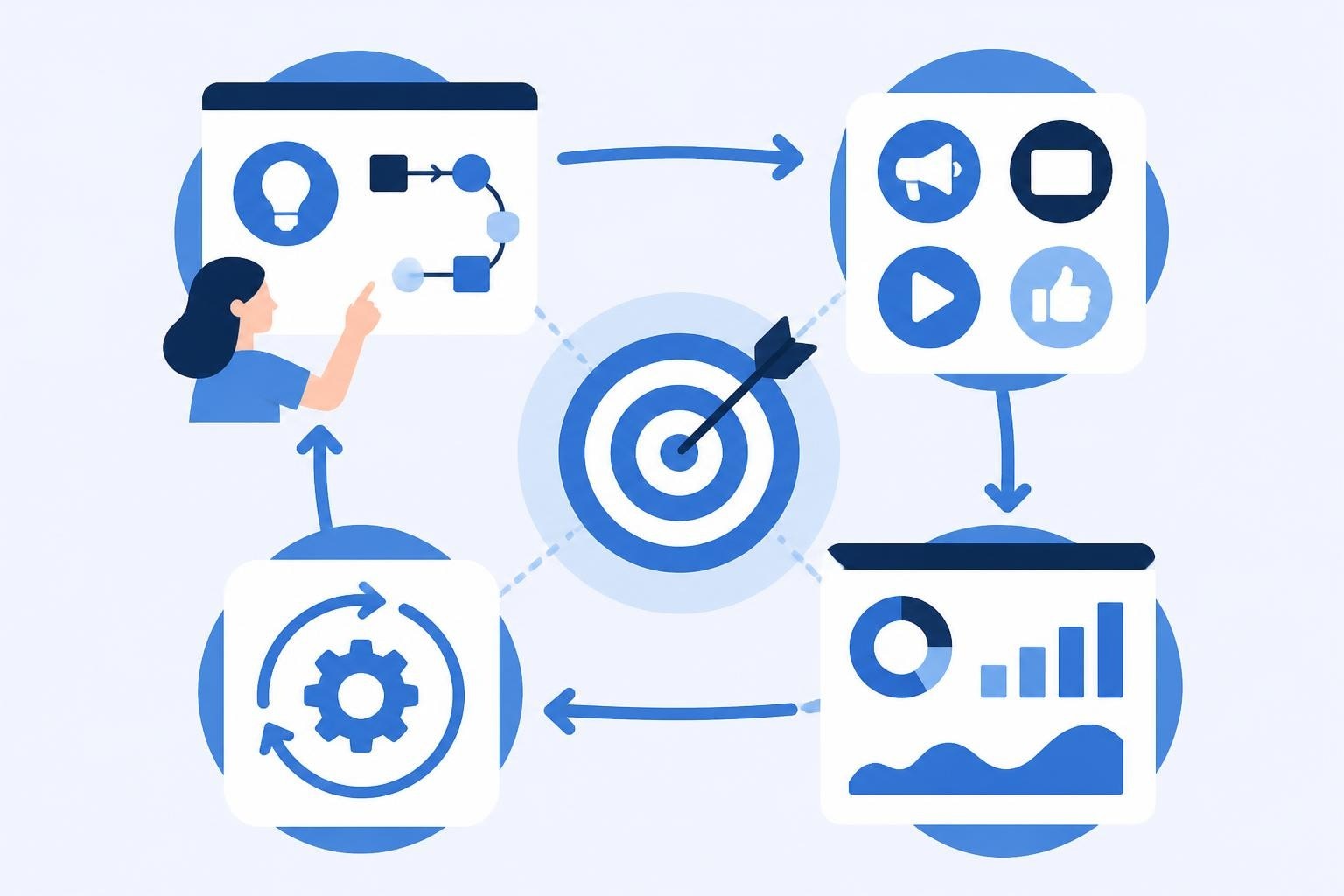
Campaign management represents the foundation of successful marketing execution across every channel and touchpoint. Whether you're launching a product, driving awareness, or converting leads, the ability to orchestrate campaigns with precision determines whether your efforts generate meaningful returns or simply consume budget. Modern campaign management extends far beyond scheduling emails or posting social content-it requires strategic planning, cross-functional coordination, sophisticated measurement, and continuous optimization to deliver sustainable business impact.
The Strategic Framework for Campaign Management
Effective campaign management begins with a clear strategic foundation that aligns marketing activities with business objectives. This framework establishes the purpose, audience, messaging, and success criteria before any tactical work begins.
Defining Campaign Objectives and KPIs
Every campaign must answer a fundamental question: what specific business outcome are we driving? Vague goals like "increase awareness" or "generate engagement" fail to provide the clarity teams need for execution and measurement. Strong campaign objectives connect directly to revenue, pipeline, customer acquisition, retention, or other quantifiable business metrics.
Key considerations when setting campaign objectives:
- Align with quarterly or annual business priorities
- Specify numeric targets with deadlines
- Ensure objectives are achievable with available resources
- Connect campaign metrics to broader company KPIs
- Define both leading and lagging indicators
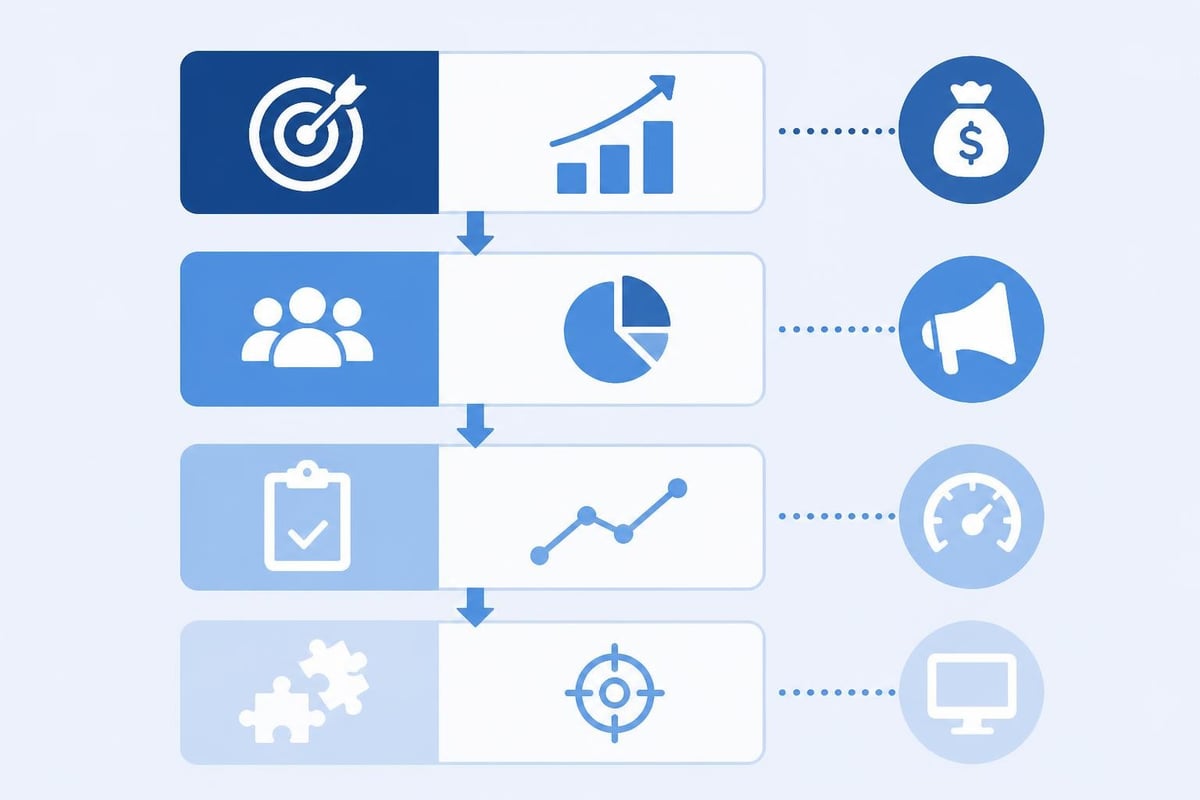
Once objectives are established, selecting the right key performance indicators becomes critical. Different campaign types demand different measurement approaches. Awareness campaigns might track reach, impressions, and brand lift, while demand generation campaigns focus on qualified leads, conversion rates, and cost per acquisition.
Audience Segmentation and Targeting
The difference between mediocre and exceptional campaign performance often comes down to audience precision. Generic messaging delivered to broad audiences generates lower response rates and wastes budget on unqualified prospects. Sophisticated campaign management leverages detailed segmentation to deliver personalized experiences that resonate with specific audience groups.
Segmentation strategies should incorporate multiple dimensions:
- Demographic data: Industry, company size, role, seniority, location
- Behavioral signals: Website activity, content consumption, product usage
- Engagement history: Email opens, event attendance, previous conversions
- Intent indicators: Search behavior, technology adoption, buying stage
- Firmographic attributes: Revenue, growth rate, technology stack, competitive presence
| Segment Type | Data Sources | Campaign Application |
|---|---|---|
| Behavioral | Website analytics, product usage, email engagement | Retargeting, upsell campaigns, re-engagement |
| Firmographic | Company databases, enrichment tools, CRM data | Account-based campaigns, industry-specific messaging |
| Intent | Search data, content downloads, comparison shopping | High-intent outreach, competitive displacement |
| Lifecycle Stage | CRM status, purchase history, product adoption | Nurture sequences, customer retention, expansion |
Building Your Campaign Infrastructure
Campaign management success depends on having the right infrastructure to execute efficiently and measure accurately. This infrastructure includes the technology stack, operational processes, and team structures that enable consistent, scalable campaign delivery.
Technology Stack and Integration
Modern campaign management platforms must orchestrate activities across multiple channels while maintaining a unified view of performance. The core technology stack typically includes marketing automation, CRM systems, analytics platforms, and specialized tools for specific channels or functions.
Integration between these systems determines whether teams work with fragmented data or unified insights. When systems communicate effectively, customer interactions across email, web, social, and advertising channels create a complete picture of the buyer journey. This visibility enables more intelligent routing, better attribution, and faster optimization.
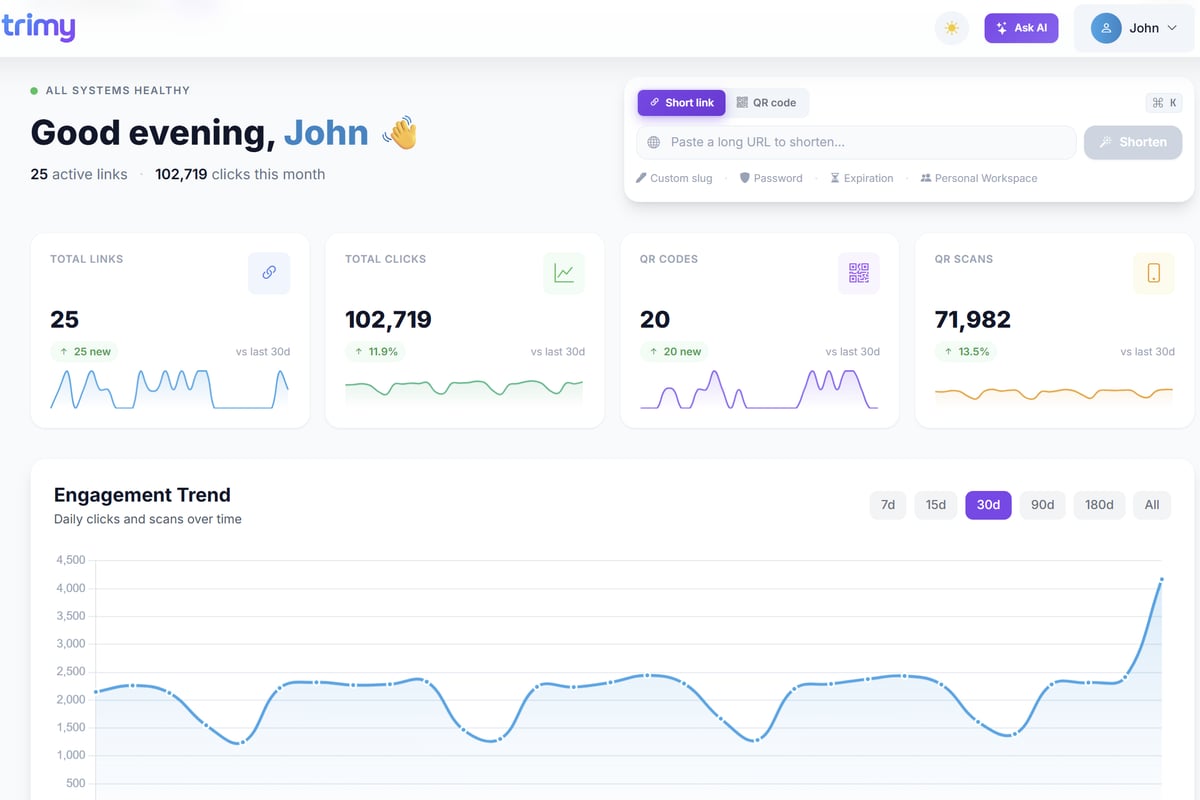
For marketers managing campaigns with significant link-based components, specialized link management becomes essential infrastructure. Trimy provides the link intelligence layer that transforms basic tracking into strategic campaign optimization, offering advanced analytics, A/B testing capabilities, smart routing, and deep insights that help marketing teams understand exactly how different audience segments interact with campaign content across channels.
Workflow Design and Approval Processes
Efficient campaign management requires clearly defined workflows that balance speed with quality control. Teams struggle when processes are either too rigid (slowing execution) or too loose (creating inconsistency and errors). The optimal workflow provides structure without bureaucracy.
Essential workflow components:
- Campaign brief template with required inputs
- Asset creation and review stages
- Technical setup and testing protocols
- Legal and compliance checkpoints
- Launch approval and scheduling
- Post-launch monitoring procedures
Best practices from Higher Logic's campaign guidance emphasize maintaining simplicity in campaign structures while establishing robust testing and monitoring protocols to catch issues before they impact audiences.
Execution Excellence in Campaign Management
Moving from planning to execution reveals where campaign management discipline truly matters. This phase requires attention to detail, proactive problem-solving, and the agility to adapt when circumstances change.
Multi-Channel Coordination
Most campaigns today span multiple channels-email, social media, paid advertising, content marketing, events, and more. Coordinating message timing, creative consistency, and audience flow across these channels represents one of campaign management's greatest challenges.
Successful multi-channel coordination follows several principles:
- Establish a master calendar showing all campaign touchpoints
- Create channel-specific content variations while maintaining core messaging
- Sequence touchpoints to build momentum and reinforce key messages
- Monitor cross-channel attribution to understand interaction effects
- Adjust channel mix based on performance data
The complexity increases significantly for account-based campaigns targeting specific companies with personalized experiences. These campaigns demand even tighter coordination between sales and marketing teams, with messaging tailored to individual stakeholders within target accounts.

Testing and Optimization Strategies
Campaign management should never rely on assumptions when data can provide answers. Systematic testing reveals which messages, offers, creative approaches, and audience segments deliver the strongest results. This intelligence compounds over time, building a knowledge base that improves every subsequent campaign.
Critical elements for testing programs:
- A/B test messaging, creative, offers, and timing variations
- Multivariate testing for complex campaigns with multiple variables
- Statistical significance thresholds to validate results
- Documentation processes to capture and share learnings
- Continuous testing calendars rather than occasional experiments
According to research on effective B2B measurement practices, marketers face significant challenges evaluating campaign effectiveness in complex media environments, making disciplined testing and measurement frameworks even more critical for understanding true campaign impact.
Measurement and Performance Analysis
Understanding what's working and what isn't separates strategic campaign management from tactical execution. Measurement provides the feedback loop that drives continuous improvement, but only when teams collect the right data and analyze it effectively.
Attribution and Tracking Implementation
Attribution determines how credit for conversions and revenue gets assigned across the multiple touchpoints in a buyer's journey. Without proper attribution, teams can't accurately assess campaign contribution or optimize budget allocation.
Different attribution models serve different purposes:
| Attribution Model | Description | Best Use Case |
|---|---|---|
| First-touch | Credits the first campaign interaction | Understanding top-of-funnel effectiveness |
| Last-touch | Credits the final interaction before conversion | Measuring conversion drivers |
| Linear | Distributes credit equally across all touchpoints | Balanced view of journey influence |
| Time-decay | Gives more credit to recent interactions | Emphasis on late-stage impact |
| Position-based | Credits first and last touch more heavily | Balancing discovery and conversion |
| Data-driven | Uses machine learning to assign credit | Most accurate with sufficient data volume |
Implementing accurate tracking requires technical precision. Every campaign element-emails, ads, social posts, landing pages-needs properly configured UTM parameters, conversion pixels, and tracking codes. Small errors in implementation can create significant blind spots in performance data.
Dashboard Design and Reporting Cadence
Campaign management teams need real-time visibility into performance metrics, but drowning stakeholders in data creates confusion rather than clarity. Effective dashboards highlight the metrics that matter most while providing drill-down capabilities for deeper analysis.
Design dashboards with role-specific views:
- Executive dashboards: High-level KPIs, budget pacing, pipeline contribution
- Campaign manager dashboards: Channel performance, audience engagement, conversion funnels
- Content team dashboards: Asset performance, engagement metrics, content ROI
- Sales dashboards: Lead quality, campaign source attribution, account engagement
Reporting cadence should match campaign tempo and stakeholder needs. Weekly performance reviews identify trends and trigger adjustments, while post-campaign analyses capture comprehensive learnings for future planning.
Team Structure and Enablement
Campaign management requires diverse skills-strategy, creative, technical, analytical-coordinated effectively. The team structure and enablement programs you build determine execution quality and scalability.
Roles and Responsibilities
Clear role definition prevents gaps and overlaps that slow campaigns and create friction. While organizational structures vary, successful campaign management typically involves these core functions:
- Campaign strategist: Develops objectives, positioning, and overall approach
- Campaign manager: Coordinates execution, timelines, and cross-functional activities
- Content creators: Produce messaging, creative assets, and campaign materials
- Technical specialists: Build landing pages, configure systems, implement tracking
- Data analysts: Monitor performance, conduct tests, generate insights
- Marketing operations: Manage platforms, maintain data quality, optimize processes
The Forrester report on campaign enablement describes how building comprehensive enablement programs aligns internal teams on goals, messaging, and execution approaches, strengthening campaign effectiveness through shared accountability and coordinated effort.
Skill Development and Best Practices
Campaign management capabilities evolve constantly as new channels, technologies, and methodologies emerge. Organizations that invest in continuous learning and knowledge sharing maintain competitive advantages in execution quality and innovation.
Key areas for ongoing skill development:
- Data analysis and interpretation techniques
- Marketing technology platform expertise
- Content strategy and creative development
- Agile marketing methodologies
- Privacy regulations and compliance requirements
Creating libraries of templates, playbooks, and documented best practices accelerates onboarding and ensures consistency. When campaign teams can reference proven frameworks rather than recreating approaches for each new initiative, execution becomes faster and more reliable.
Campaign Planning and Resource Allocation
Strategic campaign management begins months before launch with comprehensive planning that allocates resources efficiently and sets realistic timelines. Poor planning creates rushed execution, missed deadlines, and compromised quality.
Budget Planning and ROI Modeling
Campaign budgets must balance ambition with realism. Overfunding campaigns relative to expected returns wastes resources, while underfunding prevents campaigns from achieving meaningful scale. Effective budget planning starts with clear ROI expectations.
Build campaign budgets using these components:
- Media costs: Advertising spend across paid channels
- Production expenses: Creative development, content creation, design
- Technology costs: Platform fees, tool subscriptions, development work
- Personnel allocation: Internal team time and external agency support
- Contingency reserve: Buffer for unexpected needs or opportunities
Model expected ROI before committing budgets. Calculate the required conversion rates, deal values, and close rates needed to achieve positive returns. This analysis identifies whether campaign economics justify the investment or require scope adjustment.
Timeline Development and Critical Path Management
Campaign timelines must account for all dependencies, approval stages, and production requirements. Optimistic timelines that ignore realistic constraints create stress, errors, and compromised outcomes.
Use backward planning from the desired launch date:
- Define launch date and any immovable constraints
- Map all required deliverables and milestones
- Identify dependencies between tasks
- Assign realistic durations based on historical data
- Add buffer time for reviews, revisions, and approvals
- Highlight critical path items that could delay launch
Regular status reviews keep timelines on track. When delays emerge, campaign managers must quickly assess impact and adjust other elements to maintain launch dates or communicate revised expectations to stakeholders.
Compliance and Risk Management
Campaign management carries legal, regulatory, and reputational risks that demand proactive attention. Compliance failures can result in fines, legal action, and damaged customer trust that far exceeds any campaign benefits.
Regulatory Requirements Across Campaign Types
Different campaign types trigger different regulatory requirements. Email campaigns must comply with CAN-SPAM, GDPR, and similar privacy regulations. Political campaigns face specific disclosure and reporting requirements outlined in resources like the FEC's campaign guide. Financial services and healthcare campaigns navigate industry-specific advertising restrictions.
Core compliance areas for most campaigns:
- Data privacy and consent management
- Truthful advertising and substantiation requirements
- Accessibility standards for digital content
- Industry-specific regulations (financial, healthcare, etc.)
- Intellectual property and trademark usage
- Disclosure and attribution requirements
Establish compliance checkpoints in campaign workflows. Legal and compliance reviews should happen early enough to allow for modifications without derailing timelines, but late enough that reviewed materials reflect final campaign execution.
Crisis Preparation and Response Protocols
Despite careful planning, campaigns sometimes encounter unexpected crises-negative social media reactions, technical failures, offensive content interpretations, or competitive responses. How teams respond to these situations determines whether minor issues escalate into major problems.
Prepare response protocols before crises emerge:
- Define escalation paths and decision authority
- Create holding statements for common scenarios
- Establish social media monitoring and rapid response procedures
- Document system rollback and emergency shutdown processes
- Conduct post-crisis reviews to capture learnings
The speed of digital communication means campaign issues can escalate within hours. Teams need clear authority to pause or modify campaigns when problems emerge, balanced with judgment to avoid overreacting to isolated complaints.
Continuous Improvement and Learning Cycles
The most sophisticated campaign management organizations treat every campaign as a learning opportunity. They systematically capture insights, document what works, and apply those learnings to improve future performance.
Post-Campaign Analysis and Documentation
Comprehensive post-campaign analysis goes beyond reporting final metrics. It examines what drove those results, which hypotheses proved accurate, where execution differed from plans, and what unexpected insights emerged.
Essential components of post-campaign analysis:
- Performance against objectives across all KPIs
- Comparison to benchmarks and historical campaigns
- Channel-by-channel effectiveness assessment
- Audience segment performance variations
- Creative and messaging test results
- Budget efficiency and ROI achievement
- Operational execution quality review
- Key learnings and recommended actions
Document these analyses in accessible formats that future campaign teams can reference. Organizations that build institutional knowledge through systematic documentation avoid repeating mistakes and compound successful approaches over time.
Scaling What Works and Eliminating What Doesn't
Analysis only creates value when it drives action. The final step in campaign management involves scaling successful elements and eliminating or fixing what underperforms. This requires both analytical rigor and organizational courage to stop activities that aren't working.
Best practices from United Way's campaign management guide emphasize the importance of systematic planning and execution frameworks that can be refined and scaled as organizations learn what approaches drive the greatest social impact and engagement.
Create feedback loops that translate learnings into updated playbooks, revised budgets, and improved processes. When successful tactics become standardized approaches and failed experiments get documented as cautionary examples, the entire organization's campaign management capability improves with each iteration.
Mastering campaign management requires balancing strategic thinking with operational excellence, creativity with analytical discipline, and planning with agility. Organizations that build robust frameworks, invest in the right infrastructure, and commit to continuous learning consistently outperform competitors in campaign effectiveness. Trimy provides the link intelligence foundation that transforms campaign tracking into strategic advantage, delivering the deep insights and optimization capabilities marketing teams need to turn every campaign into a measurable revenue driver.