What Is Performance Marketing? Definition & Strategy Guide
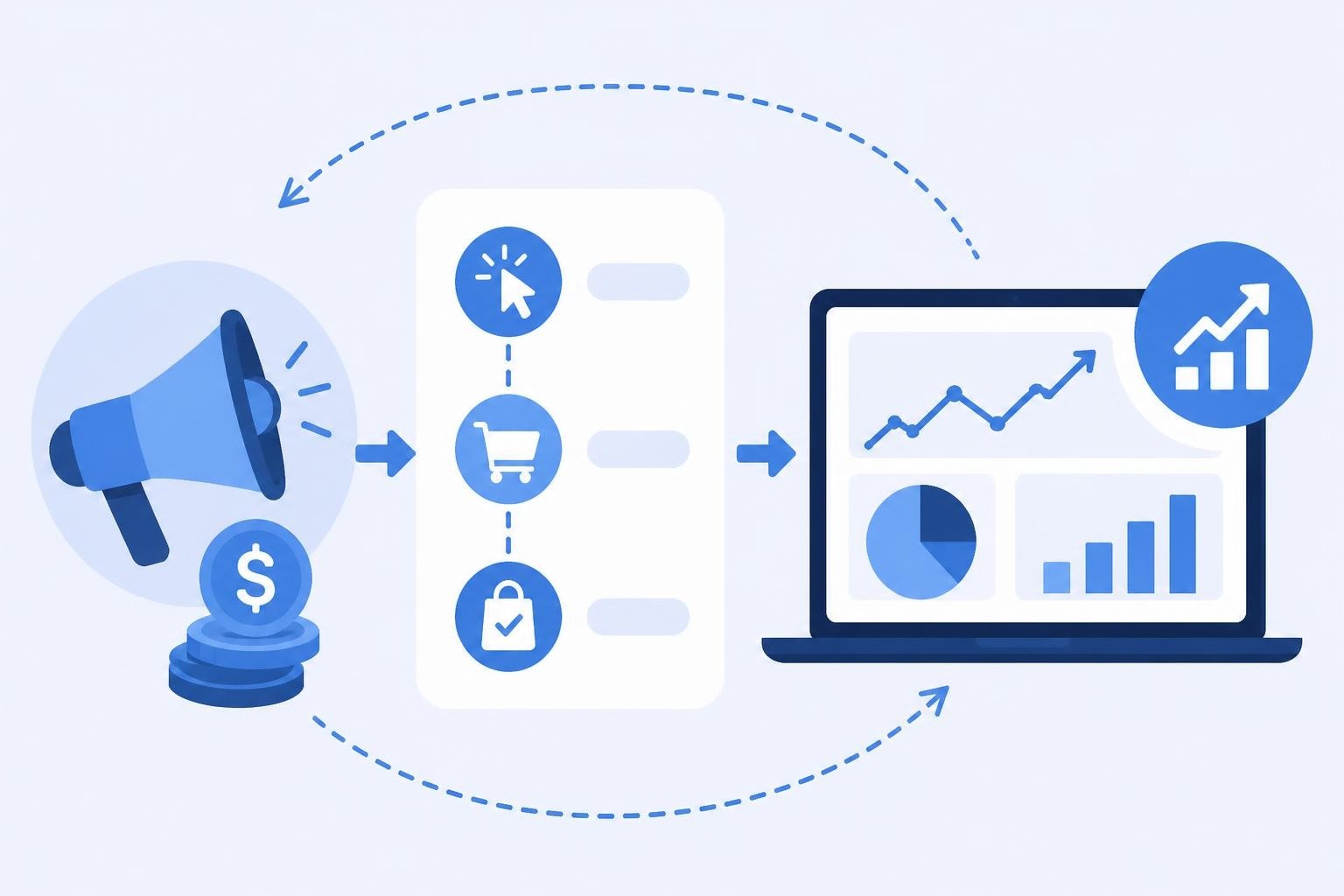
Performance marketing has fundamentally changed how businesses approach digital advertising by shifting the focus from impressions and reach to measurable outcomes and verifiable return on investment. Unlike traditional marketing models where advertisers pay upfront for exposure, performance marketing operates on a pay-for-results model that ties every dollar spent directly to specific actions: clicks, leads, conversions, or sales. This accountability-driven approach has made performance marketing the preferred framework for marketers who need to demonstrate concrete business impact, especially in an era of tightening budgets and heightened scrutiny from finance teams.
Understanding What Is Performance Marketing
What is performance marketing at its core? It is a comprehensive digital marketing strategy where advertisers pay only when a specific action is completed. These actions range from clicks and form submissions to app installs and purchases. The fundamental principle separates performance marketing from brand awareness campaigns: payment is contingent on results, not just visibility.
This model creates inherent alignment between marketing spend and business outcomes. Advertisers set clear objectives, track every interaction through the funnel, and optimize campaigns in real-time based on data. Publishers and affiliate partners earn commissions based on the actions they drive, creating a performance-based ecosystem where all parties benefit from conversion optimization.
The Pay-for-Performance Model
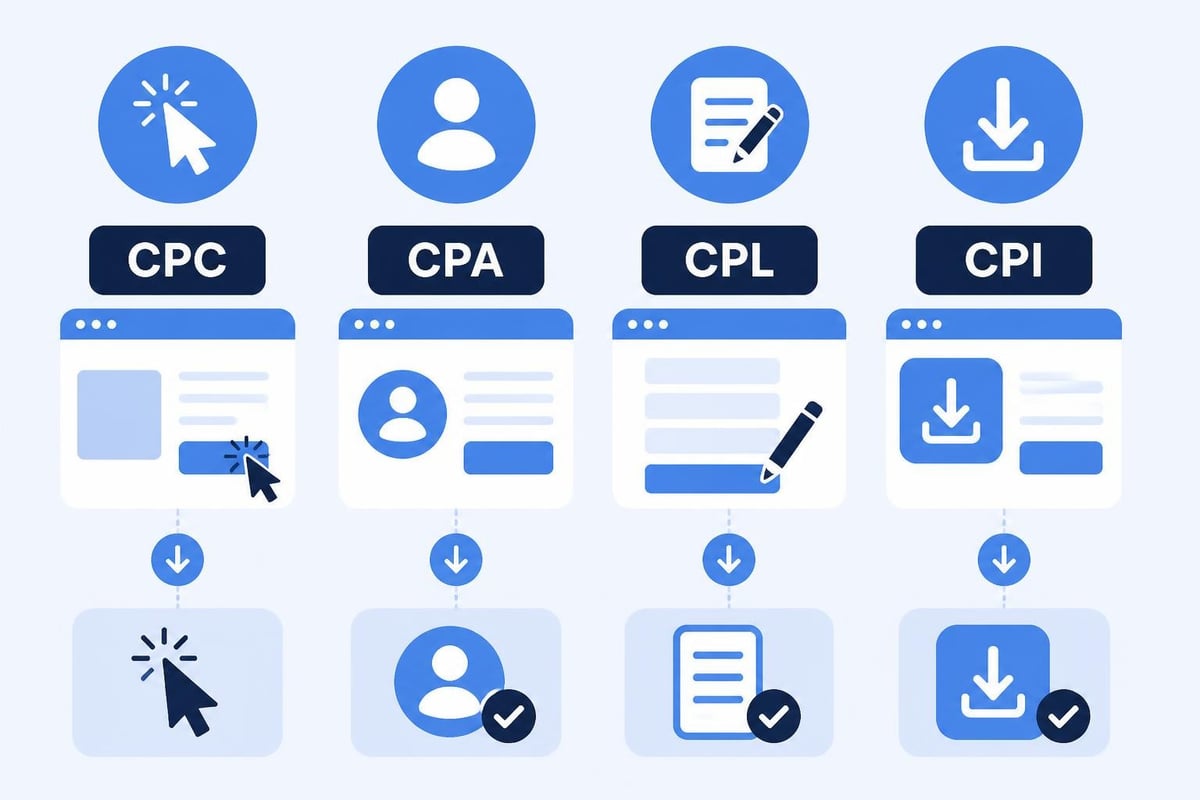
The economic structure of performance marketing revolves around several common pricing models:
- Cost-per-click (CPC): Advertisers pay each time a user clicks on an ad
- Cost-per-acquisition (CPA): Payment occurs only when a user completes a desired action (purchase, signup, download)
- Cost-per-lead (CPL): Advertisers pay for qualified lead submissions
- Cost-per-install (CPI): Common in mobile app marketing, payment for each app installation
- Cost-per-mille (CPM): Payment per thousand impressions, sometimes used in hybrid performance models
Each model serves different campaign objectives and risk tolerance levels. CPA and CPL models transfer maximum risk to publishers, while CPC offers moderate risk-sharing. The choice depends on conversion funnel maturity, average order value, and campaign goals.
Core Channels and Tactics in Performance Marketing
Performance marketers leverage multiple digital channels, each offering unique tracking capabilities and audience reach. The channel mix depends on target audience behavior, product type, and attribution windows.
Search Engine Marketing (SEM)
Paid search represents one of the most direct performance channels. Advertisers bid on keywords, and platforms like Google Ads charge per click. The beauty of SEM lies in intent-based targeting. Users actively searching for solutions signal purchase readiness, making conversion tracking straightforward.
Performance marketers obsess over quality score, ad relevance, and landing page experience. These factors determine ad rank and cost-per-click, directly impacting campaign profitability. Granular tracking through UTM parameters and conversion pixels allows precise attribution of revenue to specific keywords, ad groups, and campaigns.
Affiliate Marketing Networks
Affiliate marketing epitomizes the performance model. Brands partner with publishers, influencers, and content creators who promote products in exchange for commission on resulting sales. Affiliate networks provide tracking technology, payment processing, and fraud prevention.
Successful affiliate programs require:
- Competitive commission structures that motivate quality partners
- Robust tracking infrastructure with accurate cookie attribution
- Clear program terms and promotional guidelines
- Regular communication and creative asset updates
- Performance analytics to identify top-performing affiliates
Affiliate marketing thrives in e-commerce, SaaS, and lead-generation verticals where customer lifetime value justifies acquisition costs.
Social Media Advertising
Platforms like Facebook, Instagram, LinkedIn, and TikTok offer sophisticated targeting and conversion tracking. Performance marketers leverage pixel-based tracking to monitor user journeys from ad impression through purchase. The granular audience segmentation enables precise targeting by demographics, interests, behaviors, and lookalike audiences.
| Platform | Best For | Typical CPA Range | Key Strength |
|---|---|---|---|
| Facebook/Instagram | E-commerce, B2C | $15-$75 | Audience targeting precision |
| B2B, lead gen | $50-$200 | Professional demographic data | |
| TikTok | Youth products, viral | $10-$60 | Engagement and reach |
| Google Display | Remarketing, awareness | $20-$100 | Scale and retargeting |
Native Advertising and Content Discovery
Native ads blend into editorial content on publisher sites, driving clicks without the banner-blindness of traditional display ads. Platforms like Taboola and Outbrain operate on CPC models, making them inherently performance-focused. These channels work particularly well for content-driven conversion funnels where educational touchpoints precede purchase decisions.
Email and Retargeting
Email marketing delivers exceptional ROI when properly tracked. Performance marketers segment lists, A/B test subject lines and creative, and attribute revenue to specific campaigns through unique tracking links. Retargeting pixels capture site visitors and serve targeted ads across display networks and social platforms, bringing warm prospects back to complete conversions.
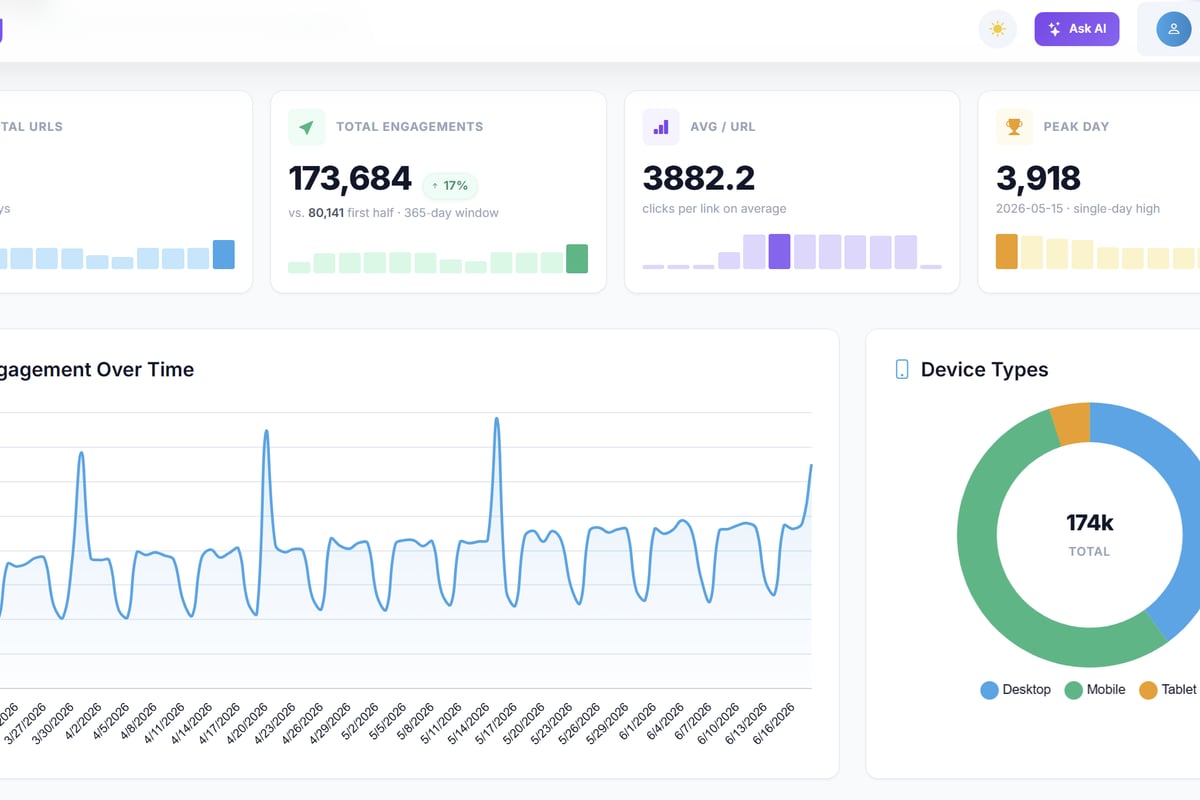
Link management platforms play a crucial role here. Marketers need granular visibility into which email campaigns, creative variants, and audience segments drive conversions. Trimy enables marketers to create trackable links with custom UTM parameters, run A/B tests on destination URLs, and measure click-through performance across every touchpoint, transforming simple links into revenue attribution signals.
Measurement and Attribution in Performance Marketing
What is performance marketing without robust measurement? The entire model depends on accurate tracking and attribution. Modern performance marketers deploy sophisticated measurement frameworks that go beyond last-click attribution to understand the full customer journey.
Attribution Models and Their Limitations
Several attribution models help marketers assign credit to marketing touchpoints:
- Last-click attribution: All credit goes to the final touchpoint before conversion
- First-click attribution: Credit assigned to the initial interaction
- Linear attribution: Equal credit distributed across all touchpoints
- Time-decay attribution: More recent interactions receive greater credit
- Data-driven attribution: Machine learning algorithms assign credit based on historical patterns
Each model offers different perspectives on campaign effectiveness. Last-click attribution, while simple, often under-values upper-funnel awareness activities. According to Google's Modern Measurement Playbook, leading marketers now combine multiple measurement approaches including marketing-mix modeling, incrementality testing, and multi-touch attribution to build comprehensive performance pictures.
Key Performance Indicators (KPIs)
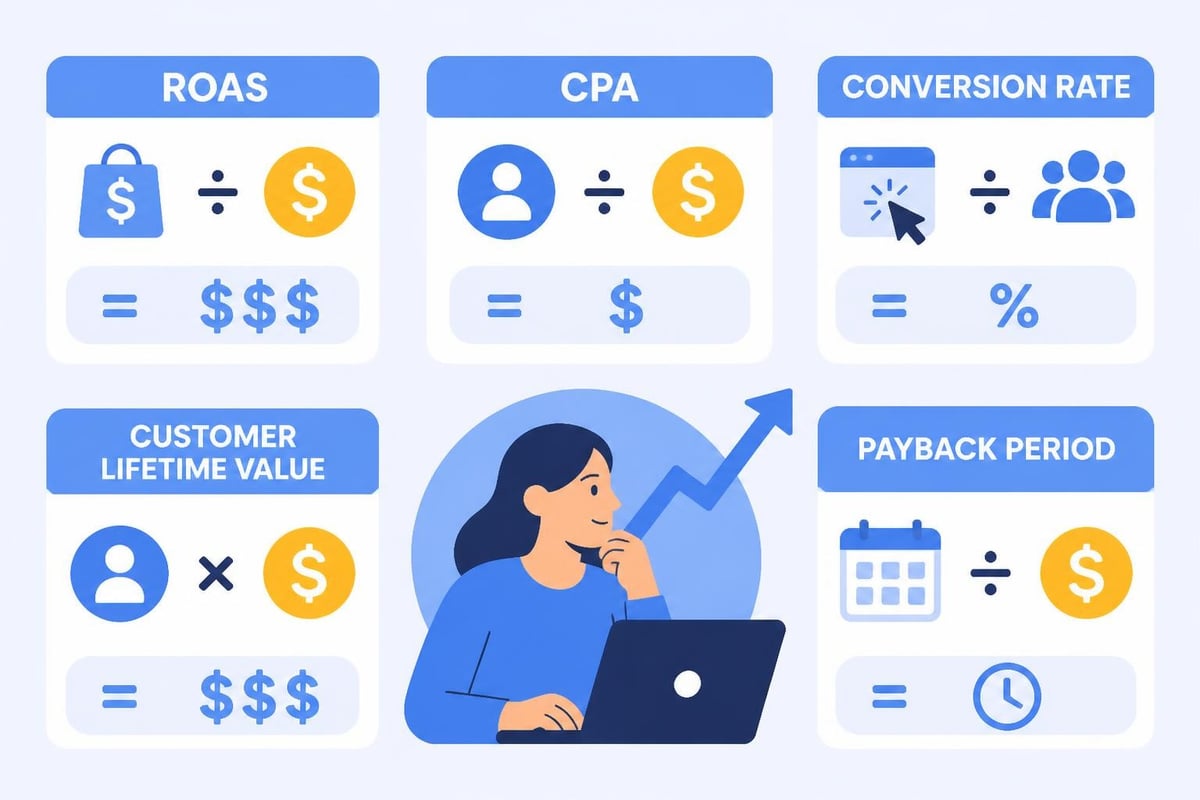
Performance campaigns live and die by specific metrics:
Return on ad spend (ROAS) measures revenue generated per dollar spent. A 4:1 ROAS means every $1 in ad spend produces $4 in revenue. This metric provides immediate feedback on campaign profitability but must be contextualized with customer lifetime value.
Customer acquisition cost (CAC) calculates total marketing and sales costs divided by new customers acquired. Comparing CAC to customer lifetime value (LTV) reveals long-term campaign viability. The LTV:CAC ratio should typically exceed 3:1 for sustainable growth.
Conversion rate tracks the percentage of visitors who complete desired actions. Optimizing conversion rates reduces acquisition costs even when traffic costs remain constant. Performance marketers obsessively test landing pages, checkout flows, and form fields to maximize this metric.
Click-through rate (CTR) and cost-per-click (CPC) indicate ad relevance and competitive position. High CTR with low CPC signals strong product-market fit and effective creative.
The Role of Testing and Optimization
Performance marketing is inherently experimental. Continuous testing reveals winning combinations of creative, targeting, offers, and landing pages. A/B testing methodologies allow marketers to isolate variables and measure impact statistically.
Smart marketers test:
- Ad creative variations (headlines, images, video)
- Audience segments and targeting parameters
- Landing page layouts and copy
- Offer structures and pricing
- Call-to-action placement and wording
Testing at scale requires proper statistical significance. Running tests too short or with insufficient traffic produces unreliable results. Performance marketers calculate required sample sizes and confidence intervals before declaring winners.
Strategic Considerations and Best Practices
Understanding what is performance marketing extends beyond tactical execution to strategic positioning within the broader marketing mix. The Harvard Business Review notes that balancing short-term performance goals with long-term brand building creates sustainable competitive advantage.
Budget Allocation and Channel Mix
Data from Nielsen's 2024 Annual Marketing Report shows leading marketers allocate 60-70% of digital budgets to performance channels, reserving 30-40% for brand awareness and upper-funnel activities. This balance maintains immediate revenue flow while building brand equity that reduces future acquisition costs.
Channel diversification protects against platform risk. Over-reliance on a single channel exposes businesses to algorithm changes, policy updates, and competitive saturation. Performance marketers monitor channel efficiency and gradually shift budgets toward highest-performing platforms while maintaining experimental budgets for emerging channels.
Privacy and Tracking Challenges
Third-party cookie deprecation, iOS privacy changes, and regulations like GDPR and CCPA have complicated performance tracking. Apple's App Tracking Transparency framework reduced attribution accuracy for iOS campaigns. Google's planned cookie phase-out requires new measurement approaches.
Forward-thinking performance marketers adapt through:
- First-party data strategies that capture customer information directly
- Server-side tracking that reduces reliance on browser cookies
- Conversion APIs that send event data directly to platforms
- Incrementality testing to measure true campaign impact
- Marketing-mix modeling for aggregate-level attribution
The IAB's Retail Media Measurement Guidelines provide industry-standard frameworks for measurement in privacy-constrained environments, emphasizing first-party data and aggregated reporting.
The Performance Marketing Skill Set
According to Forrester's analysis, modern performance marketers need diverse capabilities spanning analytics, creative, technical implementation, and strategic planning. The role requires comfort with data analysis, spreadsheet modeling, platform interfaces, and conversion psychology.
Critical skills include:
- Data analysis and interpretation: Reading campaign reports and extracting actionable insights
- Platform expertise: Mastery of advertising platforms and their optimization tools
- Conversion rate optimization: Understanding user psychology and friction points
- Technical tracking implementation: Setting up pixels, tags, and conversion events
- Budget management: Allocating spend dynamically based on performance signals
Organizations increasingly value marketers who combine quantitative rigor with creative intuition. The best performance marketers think both analytically and creatively, testing hypotheses systematically while generating innovative campaign concepts.
Advanced Performance Marketing Strategies
Sophisticated performance marketers move beyond basic channel execution to implement advanced strategies that compound results over time.
Full-Funnel Performance Approach
Traditional performance marketing focused heavily on bottom-funnel conversions. Modern approaches recognize that full-funnel media strategies build sustainable growth by nurturing prospects through awareness, consideration, and conversion stages.
Upper-funnel performance tactics include:
- Content marketing with gated assets that capture leads
- Educational video campaigns tracked through view-through conversions
- Podcast sponsorships measured via unique promo codes
- Influencer partnerships with affiliate-style tracking
Mid-funnel nurturing sequences warm prospects through email drip campaigns, retargeting ads, and content sequences. Each touchpoint advances prospects toward conversion while remaining measurable through link tracking and engagement metrics.
Predictive Analytics and Automation
Machine learning models now predict customer lifetime value, churn probability, and conversion likelihood. Performance marketers leverage these predictions to:
- Bid more aggressively on high-LTV customer profiles
- Suppress ads to predicted churners
- Dynamically adjust creative based on user signals
- Automate budget shifts between channels
Platform-native automation tools like Google's Smart Bidding and Facebook's Campaign Budget Optimization use algorithms to maximize conversions within budget constraints. Marketers set constraints and objectives; algorithms handle real-time bid adjustments across millions of auctions.
Link Intelligence and Traffic Optimization
Every marketing channel ultimately drives traffic through links. These links represent valuable data capture opportunities. Smart marketers instrument every link with tracking parameters, test multiple destinations, and analyze click patterns for optimization signals.
Advanced link management enables:
- A/B testing landing pages by routing traffic to variants
- Geo-routing to send visitors to region-specific pages
- Device-based routing optimizing mobile versus desktop experiences
- Retargeting pixel injection to capture audiences across channels
- Deep analytics revealing which campaigns, creatives, and audiences convert
Current Trends Shaping Performance Marketing
The performance marketing landscape evolves constantly as platforms update features, privacy regulations change, and consumer behaviors shift. eMarketer's analysis of 2024 marketing trends highlights several developments reshaping the discipline.
Artificial Intelligence Integration
AI tools now generate ad creative, write copy variations, and predict optimal bid strategies. Generative AI produces hundreds of creative variants for testing. Natural language processing analyzes customer reviews to extract messaging insights. Computer vision tools assess creative elements that drive engagement.
Performance marketers who effectively prompt AI systems and interpret their outputs gain significant productivity advantages. The human role shifts from pure execution to strategic direction and quality control.
Retail Media Networks
Retailers like Amazon, Walmart, and Target have built advertising platforms that allow brands to target shoppers with high purchase intent. These closed-loop ecosystems provide attribution from ad exposure through purchase, delivering the holy grail of performance marketing: precise revenue attribution.
Retail media spending grew 25% year-over-year in 2025, reaching $60 billion in the United States alone. Performance marketers allocate increasing budgets to these high-intent channels despite premium CPCs, justified by superior conversion rates and attribution clarity.
Creator Economy and Performance Partnerships
Influencer marketing evolves beyond awareness plays toward performance-based partnerships. Creators receive commission on sales driven through unique codes and tracked links rather than flat fees for posts. This shift aligns incentives and makes influencer marketing truly performance-driven.
Micro-influencers with highly engaged niche audiences often outperform celebrity partners on efficiency metrics. Performance marketers identify creators through engagement rates, audience demographics, and historical conversion data rather than follower counts alone.
Performance marketing transforms advertising from a cost center into a measurable investment by tying every dollar spent to concrete business outcomes. The discipline demands rigorous tracking, continuous optimization, and strategic balance between immediate conversions and long-term brand building. As privacy regulations and platform changes reshape the measurement landscape, marketers who build first-party data strategies and diversified channel portfolios will maintain competitive advantage. Trimy helps performance marketers maximize campaign ROI through advanced link tracking, A/B testing, and analytics that transform every click into actionable intelligence. Start optimizing your performance marketing infrastructure today to capture the revenue signals hidden in your traffic.