CPC vs CPM: Which Ad Model Drives Better ROI in 2026?
Digital advertising success hinges on choosing the right pricing model for your campaigns. The debate between cpc vs cpm remains one of the most critical decisions marketers face when allocating budgets and optimizing performance. Understanding these two fundamental pricing structures-cost-per-click and cost-per-mille (cost per thousand impressions)-can mean the difference between profitable campaigns and wasted spend. For marketers managing link-based campaigns, tracking pixels, and attribution data, selecting the appropriate model directly impacts how you measure success and allocate resources across channels.
Understanding CPC and CPM Fundamentals
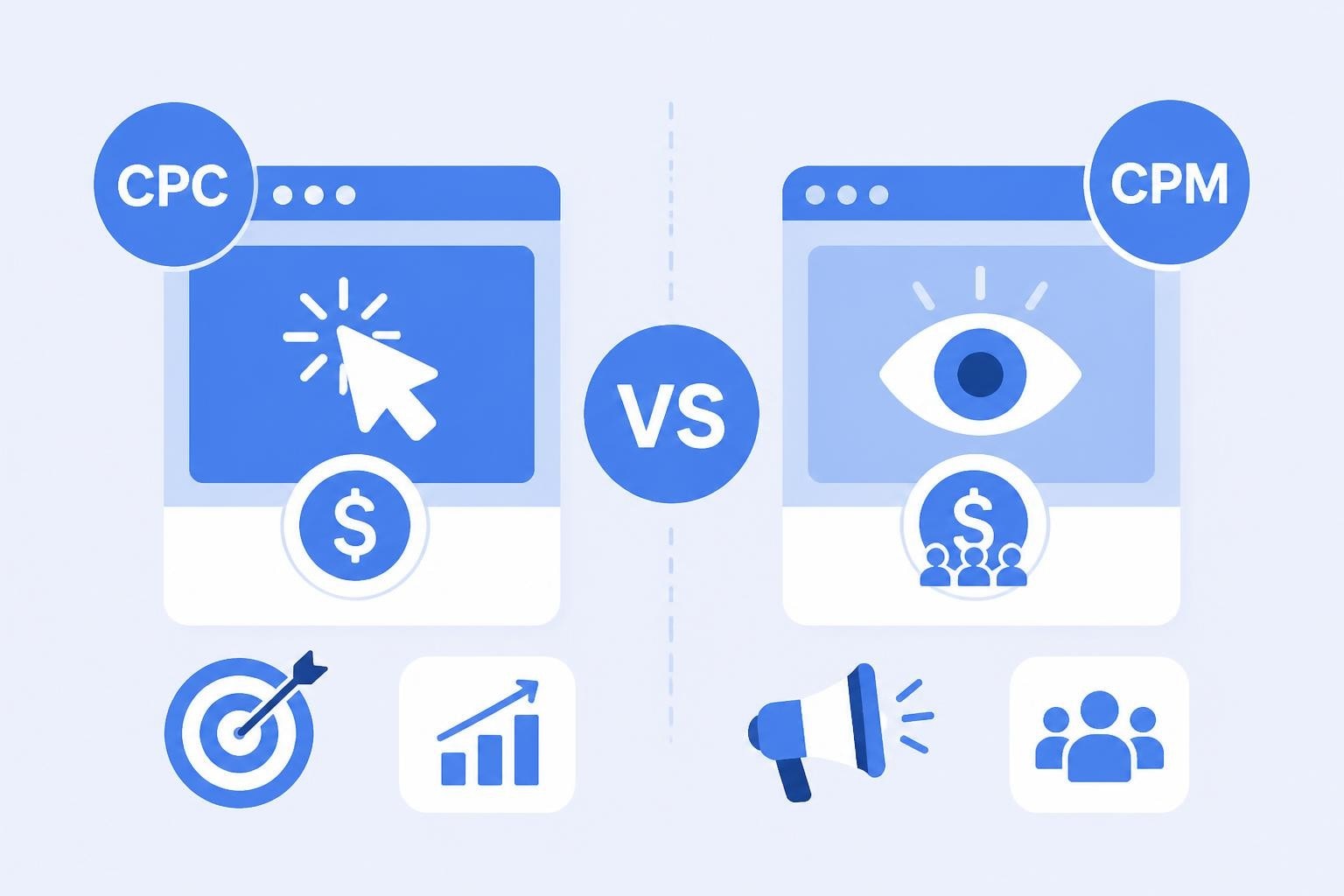
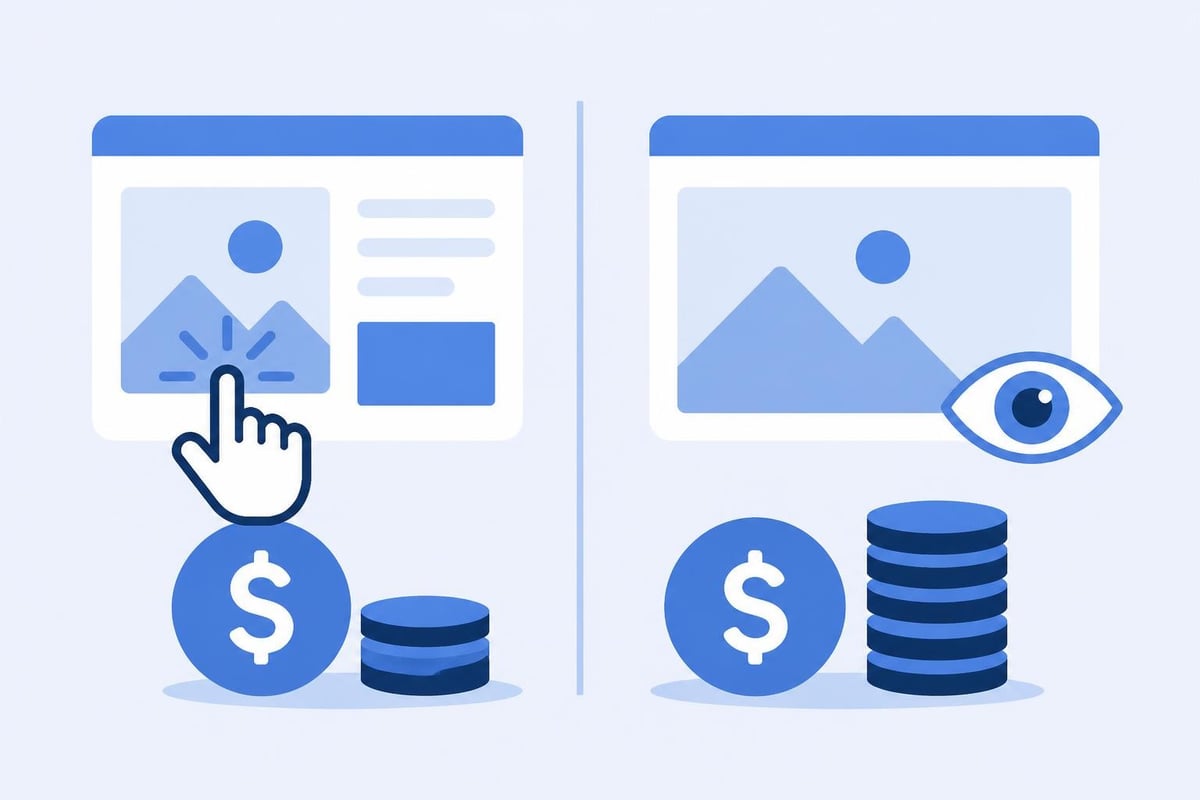
Cost-per-click (CPC) represents a pricing model where advertisers pay only when users click on their ads. This performance-based approach aligns costs directly with user engagement, making it particularly attractive for campaigns focused on driving traffic and conversions.
Cost-per-mille (CPM), also known as cost-per-thousand impressions, charges advertisers for every 1,000 times their ad appears, regardless of whether users interact with it. This model prioritizes visibility and brand awareness over immediate engagement.
Key Differences in Cost Structure
The fundamental differences between CPC and CPM pricing models extend beyond simple payment triggers:
- CPC charges per engagement - You pay only when someone clicks
- CPM charges per exposure - You pay for visibility regardless of action
- CPC focuses on quality - Emphasizes relevant traffic and conversions
- CPM focuses on quantity - Maximizes reach and brand impressions
| Pricing Model | Payment Trigger | Best For | Risk Level |
|---|---|---|---|
| CPC | User clicks ad | Direct response, conversions | Lower (pay for engagement) |
| CPM | Ad displays 1,000 times | Brand awareness, visibility | Higher (pay without guaranteed clicks) |
When to Choose CPC for Your Campaigns
CPC advertising excels in scenarios where your primary objective involves driving specific user actions. This model works particularly well for performance marketers who need to justify every dollar spent with measurable outcomes.
Ideal CPC Campaign Scenarios
Direct response campaigns benefit enormously from CPC pricing. When you're promoting limited-time offers, product launches, or lead generation initiatives, paying only for clicks ensures your budget goes toward engaged prospects. This makes CPC particularly effective for conversion-focused advertising.
E-commerce businesses often favor CPC because it aligns costs with shopping intent. If you're running campaigns to drive product purchases, service sign-ups, or free trial registrations, the CPC model provides clearer ROI tracking.
Budget control represents another significant CPC advantage. Newer brands or smaller marketing teams can test campaigns with limited risk, since you only pay when someone shows interest by clicking. This controlled spending approach allows for iterative optimization without burning through budgets on unengaged audiences.
CPC Performance Metrics That Matter
- Click-through rate (CTR) - Percentage of impressions that generate clicks
- Cost per acquisition (CPA) - Total spend divided by conversions
- Quality score - Platform assessment of ad relevance and landing page experience
- Conversion rate - Percentage of clicks that complete desired actions
- Return on ad spend (ROAS) - Revenue generated per dollar spent
For link management platforms, CPC campaigns work exceptionally well when promoting specific features or driving sign-ups. When you're directing traffic to landing pages with clear conversion goals, paying per click ensures alignment between ad spend and business outcomes.
When CPM Delivers Superior Results
CPM advertising shines in awareness-driven campaigns where impressions and reach matter more than immediate conversions. Understanding when to use CPM versus CPC metrics helps marketers maximize campaign effectiveness across different funnel stages.
Strategic CPM Use Cases
Brand awareness campaigns represent the classic CPM application. When launching a new product line, entering a new market, or building brand recognition, maximizing the number of people who see your message takes precedence over immediate clicks.
Video advertising frequently leverages CPM pricing because the value lies in message delivery rather than click-through. A 30-second product demonstration or brand story video can influence purchase decisions even without direct interaction.
Display advertising on premium publisher sites often operates on CPM models. High-visibility placements on reputable websites provide brand association benefits that extend beyond clickthrough rates.

CPM Advantages for Specific Goals
- Predictable costs - Calculate exact spend based on desired reach
- Broader exposure - Maximize audience size within budget constraints
- Upper-funnel targeting - Build awareness before driving action
- Competitive markets - Secure visibility when CPC costs are prohibitively high
| Campaign Objective | Recommended Model | Primary Metric | Secondary Metric |
|---|---|---|---|
| Product launch awareness | CPM | Impressions | Reach |
| Lead generation | CPC | Conversions | CPA |
| Brand consideration | CPM | Frequency | Engagement rate |
| Direct sales | CPC | ROAS | Conversion rate |
| Retargeting warm audiences | CPC | Click-through rate | Conversion rate |
| Market expansion | CPM | Unique reach | Brand lift |
Calculating Costs and Comparing ROI
Understanding the mathematics behind cpc vs cpm enables smarter budget allocation and more accurate performance forecasting. Both models require different analytical approaches to evaluate effectiveness.
CPC Cost Calculations
The CPC formula is straightforward: Total Cost ÷ Total Clicks = Cost Per Click
If you spend $500 and receive 250 clicks, your CPC is $2.00. However, evaluating CPC effectiveness requires looking beyond the surface number to assess conversion quality and downstream revenue.
Effective CPC analysis considers:
- Landing page conversion rate
- Average order value or lead value
- Customer lifetime value
- Multi-touch attribution across channels
CPM Math and Metrics
CPM calculations work differently: (Total Cost ÷ Total Impressions) × 1,000 = CPM
A campaign costing $500 that delivers 100,000 impressions has a CPM of $5.00. The differences between CPC and CPM ad networks often influence these baseline costs significantly.
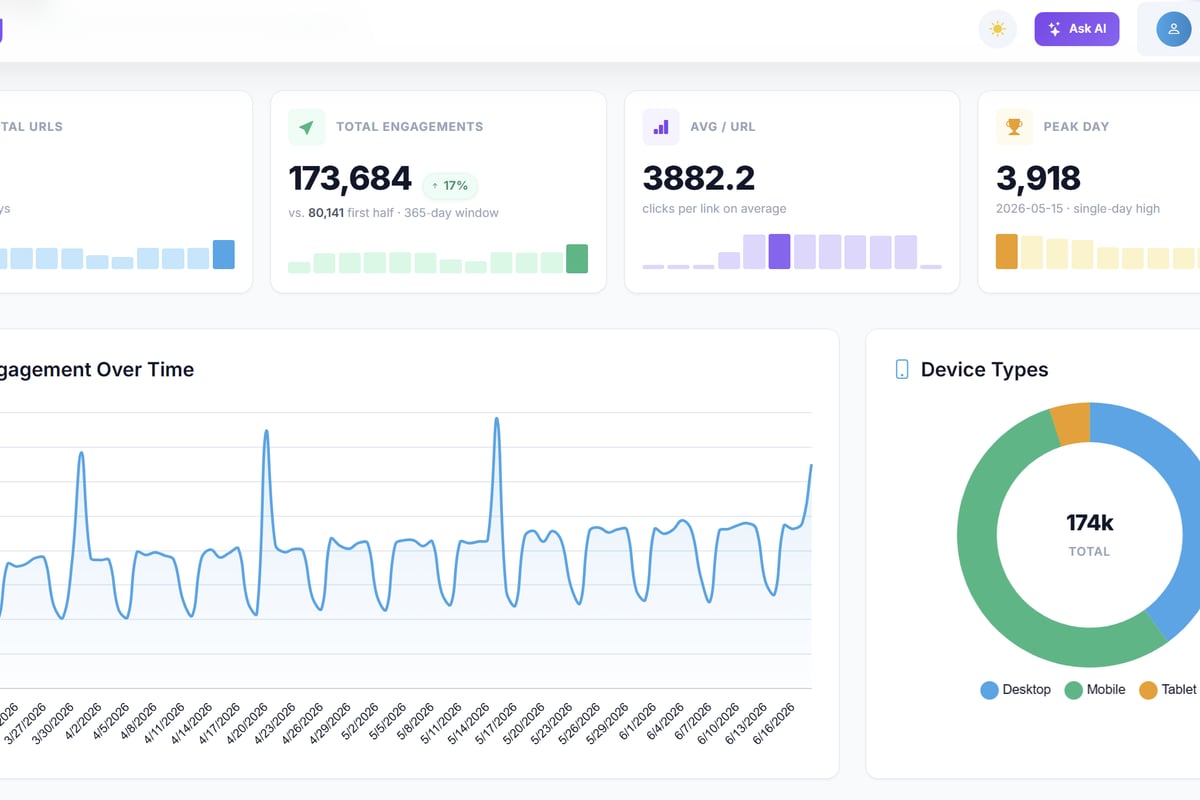
For link-based campaigns where tracking every click matters, understanding these cost structures helps optimize your routing decisions and attribution models. Trimy provides the analytics infrastructure to track campaign performance across both CPC and CPM models, transforming link data into actionable revenue insights through advanced tracking and smart routing capabilities.
Platform-Specific Considerations for CPC vs CPM
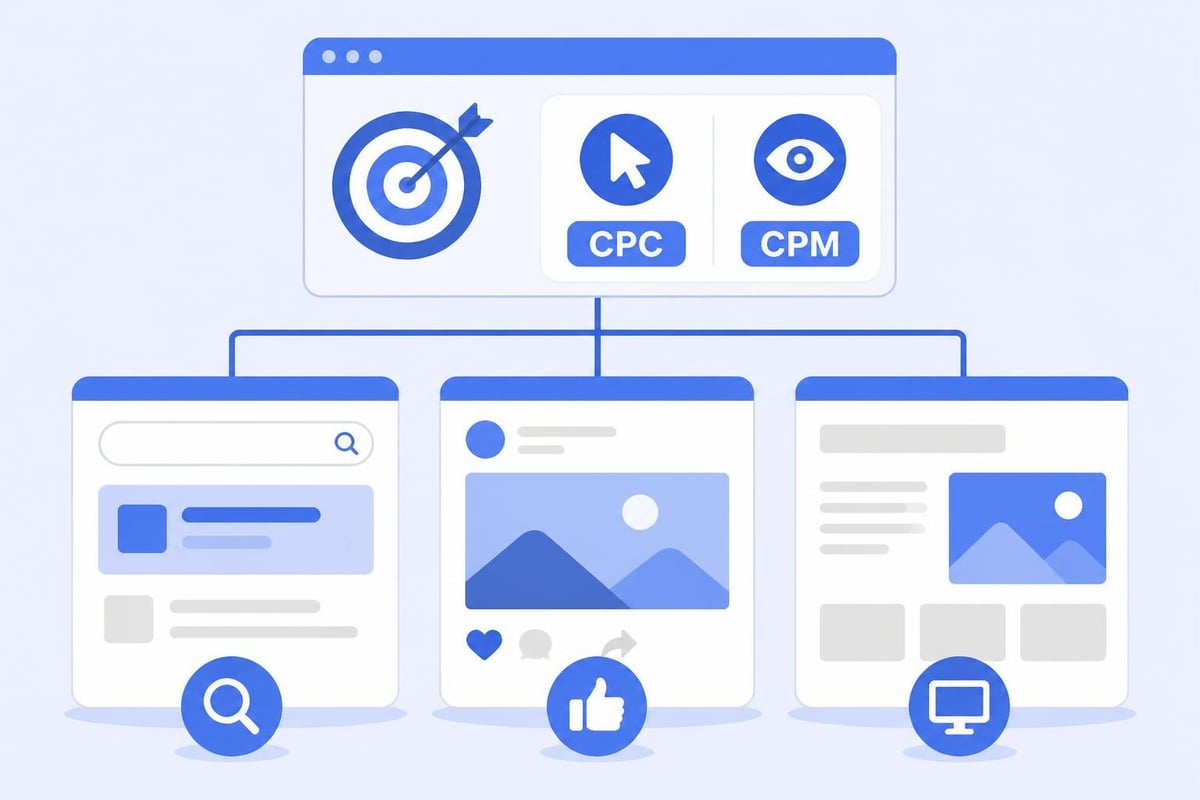
Different advertising platforms handle cpc vs cpm pricing with varying degrees of flexibility and performance. Understanding platform-specific nuances helps marketers optimize campaigns across channels.
Google Ads and Search Networks
Google Ads predominantly uses CPC for search campaigns, where user intent is high and clicks represent valuable engagement. The auction system determines actual CPC based on competition, quality score, and maximum bid.
Display campaigns on the Google Display Network offer both CPC and CPM options. Advertisers can choose based on campaign goals, though Google often recommends CPC for performance campaigns and CPM for awareness initiatives.
Social Media Advertising Models
Facebook and Instagram provide flexible bidding options including CPC, CPM, and cost-per-action (CPA) models. The platform's algorithm optimizes delivery based on your chosen objective, often automatically selecting between impression-based and click-based delivery.
LinkedIn advertising typically operates on CPC or CPM for sponsored content, with CPM often delivering lower costs for B2B awareness campaigns targeting professional audiences.
Twitter (X) offers both models, with CPM commonly used for video views and engagement campaigns while CPC works better for website traffic objectives.
Programmatic and Display Networks
Programmatic advertising platforms frequently default to CPM pricing for display inventory. Real-time bidding (RTB) environments price impressions based on audience value, context, and competition.
Optimizing Performance Across Both Models
Rather than viewing cpc vs cpm as an either-or decision, sophisticated marketers leverage both models strategically across campaign lifecycles and funnel stages.
Full-Funnel Strategy Integration
Awareness stage (CPM focus):
- Build audience reach with impression-based campaigns
- Target broad demographics and interest groups
- Maximize frequency to establish brand recognition
- Track brand lift and awareness metrics
Consideration stage (Mixed approach):
- Retarget users exposed to CPM campaigns
- Use CPC for content engagement and educational materials
- Monitor engagement rates and time-on-site metrics
- Build custom audiences for lower-funnel targeting
Conversion stage (CPC focus):
- Drive clicks from high-intent audiences
- Optimize for specific conversion actions
- Implement tight budget controls based on CPA targets
- Test landing page variations to improve conversion rates
Testing and Optimization Best Practices
Running controlled experiments comparing cpc vs cpm performance for similar audiences provides valuable insights. Comparing CPC versus CPM ads reveals that different creative approaches and audience segments perform better under each model.
A/B testing framework:
- Split budget 50/50 between CPC and CPM for identical creatives
- Measure both immediate metrics (CTR, impressions) and downstream outcomes (conversions, revenue)
- Analyze cost-per-acquisition across both models
- Consider assisted conversions and multi-touch attribution
- Adjust allocation based on performance data
Industry Benchmarks and Cost Expectations
Understanding typical costs helps set realistic budgets and identify optimization opportunities. Industry benchmarks for cpc vs cpm vary significantly across sectors and platforms.
2026 Average Costs by Industry
| Industry | Average CPC | Average CPM | Best Model |
|---|---|---|---|
| Technology/SaaS | $3.50-$7.00 | $8.00-$15.00 | CPC |
| E-commerce/Retail | $1.00-$2.50 | $5.00-$10.00 | Mixed |
| Financial Services | $4.00-$9.00 | $12.00-$20.00 | CPC |
| Healthcare | $2.50-$5.00 | $7.00-$14.00 | CPC |
| B2B Services | $3.00-$6.00 | $10.00-$18.00 | Mixed |
| Consumer Brands | $0.75-$2.00 | $4.00-$8.00 | CPM |
These ranges reflect competitive markets in 2026, where privacy changes and targeting restrictions have influenced both pricing and effectiveness.
Factors Influencing Cost Variations
Audience targeting specificity significantly impacts costs under both models. Highly refined audiences command premium prices, whether you're paying per click or per thousand impressions.
Seasonal fluctuations drive costs up during peak shopping periods like Q4 holidays or back-to-school seasons. Budget flexibility helps maintain campaign performance during competitive windows.
Creative quality and relevance affect CPC more directly than CPM, as platforms reward engaging ads with lower costs and better placement. However, compelling creative improves performance under both models by driving higher engagement rates.
Advanced Strategies for Link-Based Campaigns
For marketers managing complex link ecosystems with tracking parameters, retargeting pixels, and attribution requirements, choosing between CPC and CPM pricing models impacts more than just ad costs.
Link Management Considerations
UTM parameter tracking works seamlessly with both models, but the data signals differ. CPC campaigns generate engagement data immediately, while CPM campaigns require post-impression tracking to measure effectiveness.
Smart routing capabilities allow sophisticated marketers to direct traffic from both CPC and CPM sources to optimized destinations based on user characteristics, device type, or campaign source.
Attribution Challenges and Solutions
CPM campaigns create attribution complexity since users may see ads without clicking. View-through conversion tracking helps capture CPM influence on later conversions.
Multi-touch attribution models become essential when running concurrent CPC and CPM campaigns:
- First-click attribution credits initial discovery (often CPM-driven)
- Last-click attribution credits final conversion touch (typically CPC)
- Linear attribution distributes credit across all touchpoints
- Time-decay models weight recent interactions more heavily
Link management platforms with robust analytics help unravel these attribution puzzles, connecting impression data with click data and downstream conversions to reveal true campaign contribution.
Making Your CPC vs CPM Decision
The cpc vs cpm question lacks a universal answer because campaign context determines the optimal choice. Successful marketers evaluate multiple factors before committing budget to either model.
Decision Framework Questions
What is your primary campaign objective?
- Traffic and conversions → CPC
- Awareness and reach → CPM
- Multi-stage engagement → Both
How mature is your audience understanding?
- Well-defined, proven audiences → CPC
- Experimental targeting → CPM (lower risk)
- Retargeting known visitors → CPC
What is your budget size and flexibility?
- Limited budget, need guaranteed engagement → CPC
- Larger budget, focus on scale → CPM
- Testing budget → Split between both
How do you measure success?
- Direct response metrics (conversions, sales) → CPC
- Brand metrics (awareness, consideration) → CPM
- Blended objectives → Integrated approach
Implementation Recommendations
Start with small budget allocations to both models when entering new markets or testing new audiences. Comparing the effectiveness of CPC versus CPM through controlled experiments provides data-driven insights specific to your business.
Monitor performance weekly during initial testing phases, analyzing not just platform metrics but downstream business outcomes. Track how users from each model behave differently on your site, engage with content, and progress through conversion funnels.
Adjust allocation based on performance trends, but maintain statistical significance before making major shifts. Small sample sizes can mislead, particularly when comparing models with different conversion timelines.
Understanding cpc vs cpm fundamentals empowers marketers to allocate budgets strategically across awareness and conversion objectives. Both pricing models serve distinct purposes within comprehensive marketing strategies, and the most successful campaigns often leverage both at different funnel stages. If you're looking to maximize the value of every click and impression through advanced analytics, smart routing, and deep campaign insights, trimy transforms your links into powerful revenue signals with tools built for performance-focused marketers who demand measurable results.