What Is Social Media Marketing? A Complete 2026 Guide

Social media marketing has evolved from a novel experiment into a critical pillar of modern business strategy. As we navigate 2026, understanding what social media marketing is and how to leverage it effectively can determine whether your campaigns drive measurable revenue or simply generate vanity metrics. This comprehensive guide explores the fundamentals, strategies, and measurement tactics that define successful social media marketing in today's digital landscape.
Understanding Social Media Marketing Fundamentals
What is social media marketing? At its core, social media marketing is the strategic use of social media platforms to connect with your audience, build brand awareness, drive website traffic, and ultimately increase sales or conversions. Unlike traditional marketing channels, social media enables two-way conversations between brands and consumers, creating opportunities for engagement that were impossible just two decades ago.
The discipline encompasses both organic and paid tactics. Organic social media marketing involves creating and sharing content without direct payment to the platform, relying on compelling material to earn reach and engagement. Paid social media marketing leverages platform advertising systems to place content in front of precisely targeted audiences, often with guaranteed visibility.
The Evolution of Social Platforms
Social media platforms have matured significantly since their inception. According to recent data from Pew Research Center, platform adoption continues to shift, with different demographics gravitating toward specific networks. This fragmentation means understanding what is social media marketing requires recognizing that each platform serves distinct purposes and audiences.
- YouTube and Facebook maintain broad reach across age groups
- Instagram and TikTok dominate among younger demographics
- LinkedIn remains the professional network of choice
- X (formerly Twitter) serves niche communities and real-time conversations
- Emerging platforms continually reshape the landscape
The proliferation of platforms has created both opportunities and challenges. Marketers must now decide where to invest resources, how to adapt content for each environment, and which metrics truly matter for business outcomes.

Core Components of Social Media Marketing Strategy
A comprehensive approach to what is social media marketing involves several interdependent components working in concert. Each element plays a specific role in achieving your business objectives.
Content Creation and Distribution
Content remains the currency of social media marketing. High-quality, relevant content attracts attention, sparks conversation, and drives action. In 2026, content formats have diversified beyond simple text and image posts to include:
- Short-form video (Reels, TikToks, YouTube Shorts)
- Live streaming for real-time engagement
- Stories that disappear after 24 hours
- Long-form articles on platforms like LinkedIn
- Interactive polls, quizzes, and Q&A sessions
- User-generated content campaigns
The HubSpot social media marketing glossary provides detailed explanations of current content formats and tactical approaches that marketers employ across platforms.
Audience Targeting and Segmentation
Understanding your audience represents half the battle in social media marketing. Platforms collect vast amounts of data about user behavior, interests, and demographics, enabling sophisticated targeting capabilities. Marketers can segment audiences by:
| Targeting Criterion | Example Applications |
|---|---|
| Demographics | Age, gender, location, language |
| Interests | Hobbies, followed pages, content engagement |
| Behaviors | Purchase history, device usage, travel patterns |
| Custom Audiences | Email lists, website visitors, app users |
| Lookalike Audiences | Users similar to your best customers |
This granular targeting explains why social media marketing often delivers superior ROI compared to traditional broadcast channels. You're not paying to reach everyone-just those most likely to care about your message.
Paid Advertising Frameworks
While organic reach has declined on most platforms over recent years, paid advertising has become increasingly sophisticated. Meta's advertising options for Facebook, Instagram, and Reels demonstrate the creative flexibility available to marketers who invest in paid social.
Campaign objectives in paid social typically align with the marketing funnel:
- Awareness: Brand awareness, reach
- Consideration: Traffic, engagement, app installs, video views, lead generation
- Conversion: Conversions, catalog sales, store traffic
Each objective optimizes ad delivery differently, ensuring your budget focuses on the outcomes that matter most to your business.
Measurement and Analytics in Social Media Marketing
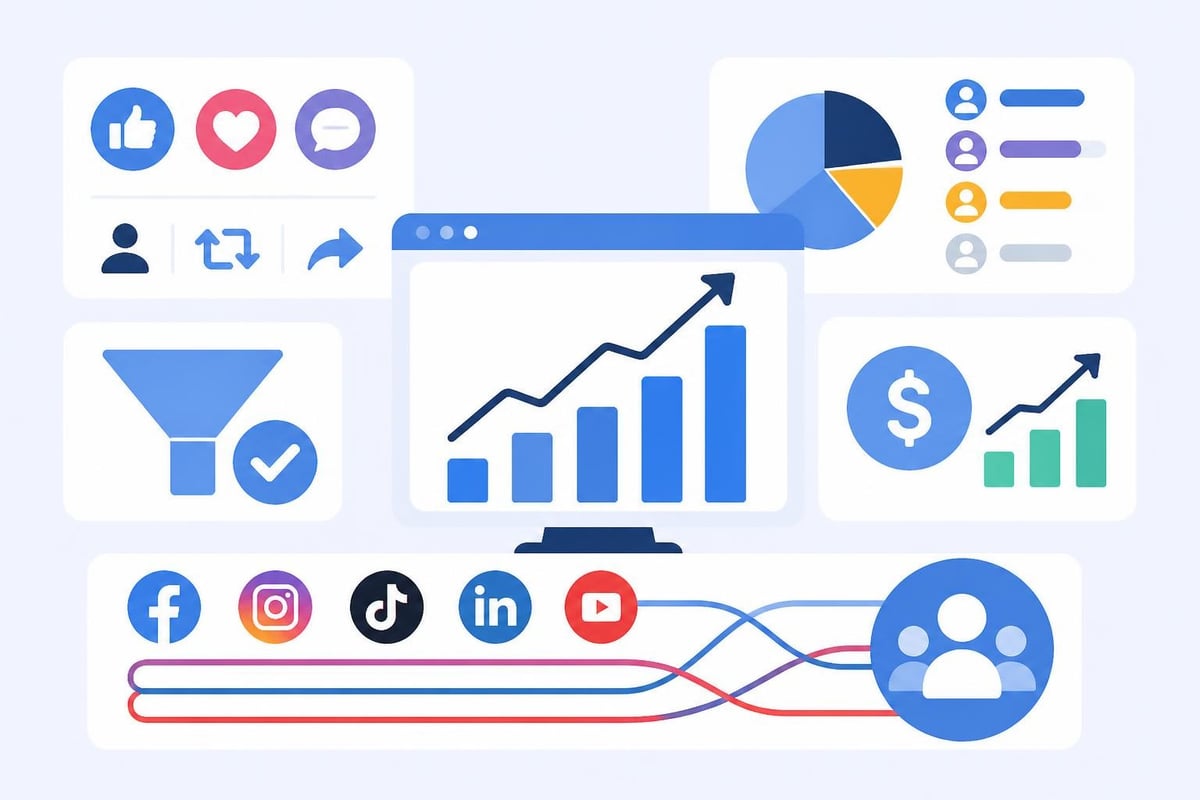
Understanding what is social media marketing requires grasping how to measure its impact. Unlike billboards or TV commercials, social media generates abundant data about who sees your content, how they interact with it, and what actions they take afterward.
Key Performance Indicators
Different KPIs matter depending on your campaign goals. A recent review in the Review of Managerial Science examined how organizations measure social media marketing performance and the challenges they encounter in attribution.
Common metrics include:
- Reach: Unique users who saw your content
- Impressions: Total times your content was displayed
- Engagement rate: Interactions divided by reach or impressions
- Click-through rate: Clicks divided by impressions
- Conversion rate: Desired actions divided by clicks
- Cost per result: Total spend divided by conversions
- Return on ad spend (ROAS): Revenue generated divided by ad spend
Vanity metrics like follower count or total likes often receive disproportionate attention despite limited correlation with business outcomes. Sophisticated marketers focus instead on metrics tied directly to revenue, customer acquisition cost, and lifetime value.
Attribution Challenges and Solutions
One complexity in answering what is social media marketing involves tracking the customer journey from initial awareness to final purchase. Social platforms typically receive credit for "last-click" conversions, but users often interact with multiple touchpoints before converting.
Advanced attribution models account for this reality:
- First-touch attribution: Credits the initial interaction
- Last-touch attribution: Credits the final interaction before conversion
- Linear attribution: Distributes credit evenly across all touchpoints
- Time-decay attribution: Gives more credit to recent interactions
- Data-driven attribution: Uses algorithms to assign credit based on actual impact
Link management becomes crucial in this context. When you share links across social platforms, tracking parameters (UTM codes, for instance) enable you to identify which specific posts, campaigns, and platforms drive valuable actions. Trimy provides the infrastructure to create shortened, trackable links with custom UTM parameters, run A/B tests on landing pages, and gather deep analytics about traffic sources-transforming every social media link into a measurable revenue signal.

Platform-Specific Strategies and Best Practices
What is social media marketing on Facebook differs substantially from TikTok or LinkedIn. Each platform has unique characteristics, user expectations, and algorithmic priorities.
Facebook and Instagram Marketing
Meta's platforms remain dominant despite increased competition. Facebook excels at community building through Groups, while Instagram prioritizes visual storytelling. Both platforms favor content that generates meaningful interactions-comments and shares over passive likes.
Best practices:
- Post consistently but prioritize quality over quantity
- Use Stories for behind-the-scenes content and time-sensitive offers
- Leverage Reels for discovery and reach beyond your current followers
- Test different content formats to identify what resonates
- Engage authentically in comments and direct messages
LinkedIn for B2B Marketing
LinkedIn has evolved into the primary platform for B2B social media marketing. Decision-makers use the platform to research solutions, follow industry thought leaders, and stay informed about their sectors.
| Content Type | Performance Characteristics |
|---|---|
| Thought leadership articles | High engagement from professionals, establishes expertise |
| Company updates | Moderate reach, good for announcements |
| Employee advocacy | Expands reach through personal networks |
| Video content | Growing engagement, especially for tutorials and insights |
| Polls and questions | High interaction rates, valuable audience research |
Short-Form Video Platforms
TikTok, Instagram Reels, and YouTube Shorts have fundamentally changed what is social media marketing by prioritizing entertainment value and algorithmic discovery over follower graphs. A brand-new account can generate millions of views if content resonates with viewers.
This represents both opportunity and challenge. The potential for viral reach is unprecedented, but sustaining attention requires continuous creative innovation.
Influencer Marketing and User-Generated Content
The rise of influencer marketing reflects a core truth about social media: people trust people more than brands. A comprehensive meta-analysis published in the Journal of the Academy of Marketing Science examined when and why influencer marketing drives results.
Influencer Partnership Strategies
Effective influencer collaborations align creator authenticity with brand values. The spectrum ranges from:
- Nano-influencers (1,000-10,000 followers): High engagement, niche audiences
- Micro-influencers (10,000-100,000 followers): Strong community connections
- Mid-tier influencers (100,000-500,000 followers): Balance of reach and engagement
- Macro-influencers (500,000+ followers): Broad awareness potential
- Celebrities: Maximum reach, variable engagement
Compensation models vary from product gifting to performance-based payments tied to sales or leads generated through unique links or codes.

User-Generated Content Campaigns
Encouraging customers to create content about your brand generates authentic social proof while reducing content production burden. Successful UGC campaigns provide clear participation guidelines, compelling incentives, and showcase the best submissions to inspire further participation.
Privacy, Data Ethics, and Regulatory Considerations
As social platforms collect increasingly detailed user data to enable precise targeting, privacy concerns have intensified. The FTC's 2024 report on social media data practices highlights how platforms monetize user information and the regulatory scrutiny this attracts.
Understanding what is social media marketing in 2026 means navigating:
- GDPR compliance for European audiences
- CCPA requirements in California and expanding U.S. privacy laws
- Platform policy changes that restrict tracking and targeting
- Disclosure requirements for sponsored content and influencer partnerships
- Data retention and security practices
Ethical marketers balance performance objectives with respect for user privacy, transparent data practices, and compliance with evolving regulations.
Social Commerce and Direct Monetization
Social platforms increasingly enable direct transactions without requiring users to leave the app. Instagram Shop, Facebook Marketplace, TikTok Shopping, and Pinterest Product Pins blur the line between content discovery and purchase completion.
This evolution changes what is social media marketing from a top-of-funnel awareness channel into a complete commerce ecosystem. Brands can:
- Tag products in posts and Stories
- Create shoppable video content
- Enable one-click checkout within apps
- Run dynamic product ads based on catalog
- Retarget cart abandoners with specific products
The Nielsen 2024 Annual Marketing Report provides industry benchmarks on social media ROI and budget allocation trends, helping marketers justify investments in these emerging capabilities.
Real-World Impact and ROI Evidence
Academic research increasingly demonstrates social media marketing's measurable business impact. A peer-reviewed study published in Frontiers in Sustainable Food Systems documented specific sales effects from social media campaigns in a controlled experimental setting, providing concrete evidence of ROI beyond platform-reported metrics.
Documented benefits across industries include:
- Reduced customer acquisition costs compared to traditional channels
- Improved brand sentiment and awareness
- Higher customer lifetime value through community building
- Faster product launch adoption through influencer partnerships
- Enhanced customer service and satisfaction through responsive engagement
The key lies in connecting social media activities to business outcomes through proper tracking infrastructure and attribution modeling.
Building a Sustainable Social Media Marketing Operation
Long-term success requires systematic approaches rather than random acts of social media. Organizations that excel at social media marketing typically implement:
Governance and Workflow
- Content calendars that align with business priorities and seasonal opportunities
- Approval processes that balance brand safety with agility
- Response protocols for customer inquiries, complaints, and crises
- Role definitions clarifying who creates, approves, publishes, and monitors content
Technology Stack
Modern social media marketing relies on integrated tools:
| Tool Category | Purpose |
|---|---|
| Scheduling platforms | Plan and automate posting across networks |
| Analytics suites | Aggregate performance data and generate insights |
| Listening tools | Monitor brand mentions and industry conversations |
| Asset management | Organize creative files and maintain brand consistency |
| Link management | Track traffic sources and optimize campaign performance |
Continuous Optimization
The social media landscape evolves constantly. Algorithm changes, new features, platform updates, and shifting user behaviors require ongoing testing and adaptation. High-performing teams allocate time for:
- A/B testing different creative approaches, copy variations, and posting times
- Competitive analysis to identify opportunities and threats
- Trend monitoring to capitalize on emerging conversations
- Skills development as platforms introduce new capabilities
Understanding what is social media marketing provides the foundation for developing campaigns that drive real business results. As platforms evolve and user expectations shift, the principles remain constant: create valuable content, engage authentically with your audience, measure what matters, and optimize based on evidence. Trimy helps marketers transform social media links into intelligent assets with advanced tracking, A/B testing, and deep analytics-ensuring every campaign delivers measurable insights and optimized performance.